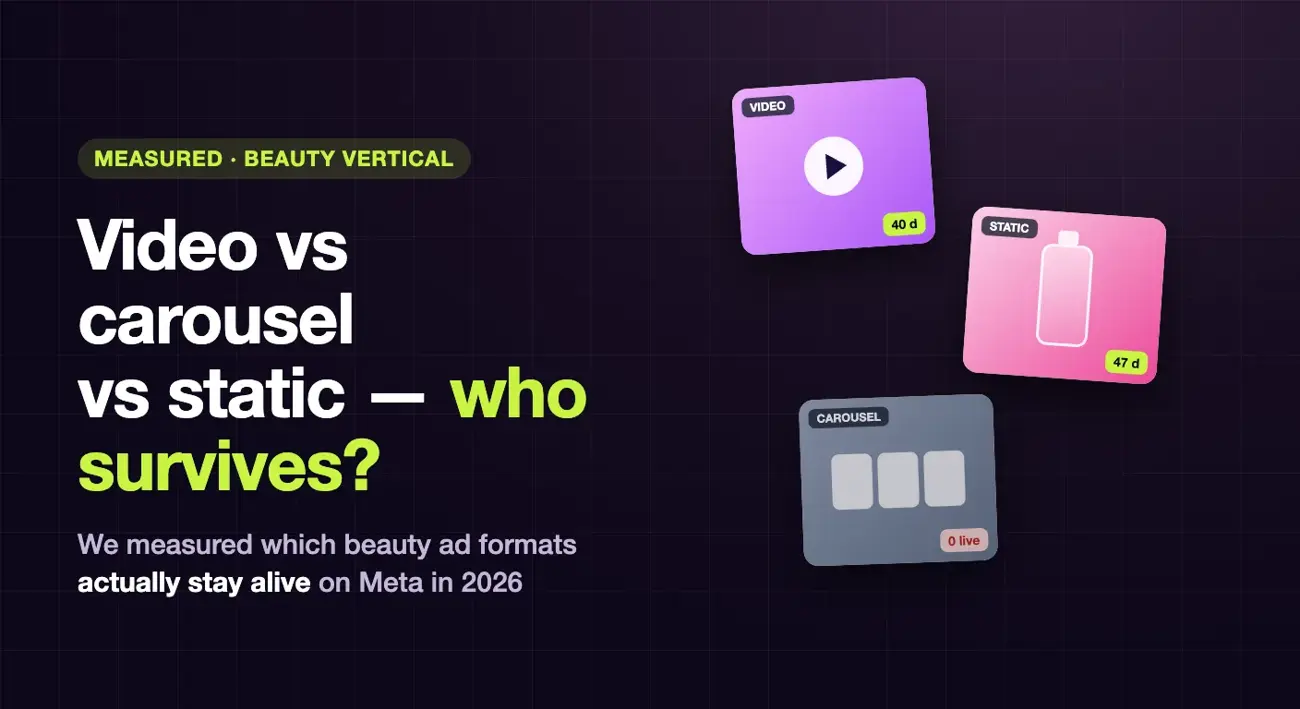
Video vs Carousel vs Static: Which Beauty Facebook Ad Formats Actually Survive in 2026
Every beauty team has had this meeting. The founder wants more video because "video wins." The designer defends statics because they are cheap and fast. Someone suggests carousels because a swipe of shades "shows the range." Then everyone votes based on feelings, because nobody has data.
We do. Our library records every ad's format and how long it stays alive — so instead of arguing, we measured. On August 21, 2026 we counted every live ad matching three beauty keyword sets in the US market ("serum", "collagen", "hair growth"), split them by format, and checked which formats actually survive past the two-week mark. The result settles the debate — and one finding surprised even us: an entire format has quietly gone extinct in beauty.
One method note up front: these are keyword-level samples, not "the whole beauty vertical" — beauty is enormous and no single keyword captures it. Three named sets, measured the same way, are enough to see the format pattern clearly.
The question every beauty team argues about (and answers with opinions)
Format debates persist because the usual evidence is unfalsifiable: engagement screenshots, "our audience loves reels," a competitor's pretty carousel someone saw once. Meta's own guidance is generically pro-every-format, and creative-agency blogs recommend whatever they sell.
The observable truth is different: advertisers keep paying only for formats that convert. If beauty carousels made money, beauty carousels would be running. If statics were dead, nobody would launch them. Which means the live-ad census of a niche — what formats are running right now, and which survive — is the closest public thing to seeing everyone's private performance dashboards at once.
How we measured it: survival data instead of engagement guesses
The method is reproducible in any ads library that records formats and active days (Meta's own Ad Library records neither counters nor lifespans, which is why this article couldn't be written from it):
- Live pool: every ad matching the keyword, targeting the US, seen active within the last 3 days (Aug 21, 2026).
- Format split: the same query filtered by display format — video, static image, carousel.
- Survivors: the same query with a minimum-active-days threshold (14 and 30 days).
Full disclosure on data hygiene, because keyword sets bite: sorting the serum pool by longevity, the #1 "beauty" ad at 182 days turned out to be a bass-preset pack for Serum, the music synthesizer. Keyword collisions are real; we excluded it from beauty conclusions. This is also why we back the keyword sets with brand-page data (Medicube, 594 ads) later on. How to slice any niche by GEO and vertical without these traps is its own guide.
Want this census for your niche? Run the same format census — free in Adligator
The headline split: video dominates surviving beauty ads
Here is the live-format census (US, seen active within 3 days, Aug 21, 2026):
| Keyword set | Live ads | Video | Static image | Carousel |
|---|---|---|---|---|
| serum | 90 | 73 (81%) | 13 (14%) | 0 |
| collagen | 87 | 55 (63%) | 23 (26%) | 0 |
| hair growth | 32 | 14 (44%) | 7 (22%) | 0 |
 The measured split across three beauty keyword sets — the carousel column is the story nobody expected
Video is the working language of live beauty advertising — in the serum set it is a 4-in-5 majority. Scroll the actual results and the pattern is visceral: play buttons on almost every card, and the creatives are overwhelmingly UGC-style — a problem shown in close-up (dark spots, thinning crown, under-eye lines), a hands-on application shot, a before/after arc, a spoken hook. Polished studio spots are the minority; phone-shot authenticity is the norm.
 The live serum set at a glance: play buttons on nearly every card — 81% of currently running serum ads are videos
The survivors' club is thin, though. Only 13 of 90 live serum ads (14%) had passed 14 days; just 2 had passed 30. In the wider 30-day-window collagen sample we measured a week earlier (Aug 15, 2026; base ≈1,290 ads), 2.1% reached 30 days and 0.4% reached 90. Beauty is a fast-churn vertical — the cross-niche lifespan study puts these numbers in context — which makes every survivor disproportionately informative.
What the surviving static ads have in common
Now the twist the "video wins" crowd misses: statics punch above their weight in survival. The longest-running live beauty ad in the entire serum set is not a video — it is a static: Beauty From Bees' "Get 1 FREE Full Sized 2oz Bottle of Face Oil," at 47 days. The longest-running live videos in our sets top out lower: a med-spa collagen video at 40 days, a hair-growth video at 25. And in our broader cross-vertical measurement, video and image survival rates were statistically twins (8.4% vs 8.3% reaching 30 days in the same keyword set).
The surviving beauty statics share a formula:
- Offer-led, not vibe-led. A concrete deal in headline-sized type: "FREE full-sized bottle," "Buy 1 Get 1." The image sells arithmetic, not aesthetics.
- Product-forward. Clean product shots or simple trios — not lifestyle moodboards.
- Claim-safe framing. Ingredient stories and value framing rather than aggressive transformation promises — the statics that survive are the ones moderation never needs to revisit.
The practical read: video earns the impressions, but a disciplined offer-static is the cheapest lottery ticket in beauty — produced in an hour, and when one sticks, it sticks for months.
Why carousels almost never survive in beauty — and the exception
The zero in the carousel column is not a sampling glitch. Three keyword sets, 209 live ads, not one live carousel. The format exists in beauty only as an archive: our library holds roughly 85 lifetime carousels per keyword set, every one of them inactive today.
Why beauty kills carousels: the vertical sells one hero product per funnel (a serum, a cap, a supplement), and its buying trigger is a single transformation story. A card deck dilutes the one thing beauty ads must do — land one problem, one promise, one product. Meta's delivery seems to agree: budgets flow to the formats that convert, and carousels stopped receiving them.
The exceptions prove the rule. The longest-lived beauty carousels in the archive are multi-product catalog plays: Japan With Love ran a curated "beauty essentials list" carousel for 774 days; Meisani (436 days), BENA (386) and Ruhi (363) all carousel-ed product collections, not single heroes. If you genuinely sell a range — shades, bundles, a routine — the catalog carousel is the one variant with a track record. If you sell one hero product, the data says skip the format entirely.
Format survival by sub-niche: serums, anti-aging, hair care
The aggregate hides useful texture. Same census, read by sub-niche (all Aug 21, 2026):
- Serums / skincare — the most video-saturated slice (81%) and the most collision-prone keyword. Live champions: Rova Beauty's retinal-booster UGC videos (19 days, running a "Buy 1 Get 1 FREE" offer against body-skin dark spots) and the 47-day Beauty From Bees offer-static. The winning grammar: close-up problem → texture shot → deal.
- Anti-aging / collagen — the most format-diverse slice (26% statics) and the one place local players surface: the longevity leader is a plastic-surgery clinic's video (40 days, 3 copies) running geo-targeted lead-gen to a promo opt-in page. Advertorial-style "collagen research" statics from content pages fill the mid-tail.
- Hair care / hair growth — the smallest live set (32 ads) but the clearest survivor profile: both 14-day-plus survivors are videos, led by "Korea's Secret To Fuller, Thicker Hair" (25 days, 6 copies, 96 GEOs) — story-driven UGC with a listicle lander. Devices (red-light caps) and "replaces minoxidil" serums dominate the fresh tests.
Three sub-niches, one conclusion with different accents: video is the default everywhere, statics survive where the offer is sharp, and nobody anywhere is betting on carousels.
Two reading mistakes to avoid with sub-niche data. First, don't extrapolate a thin slice — 32 live hair-growth ads is a real signal about format shares, but not enough to declare hook "winners"; re-pull the census before a production sprint. Second, don't treat a sub-niche's biggest advertiser as its format oracle: local lead-gen clinics, DTC brands and affiliate publishers each run different format economics inside the same keyword, which is exactly why the census beats copying any single player.
How to run this analysis for your own niche in 15 minutes
The census above is three searches per keyword. The repeatable recipe:
- Map your keyword set first (5 min). Pick 3–5 buyer-language phrases and product names — not the vertical word. Sanity-check the top longevity results for collisions (remember our synthesizer).
- Count the live pool and format splits (5 min). Keyword + GEO + "seen active ≤3 days," then the same with each format filter. Sort by longest running — your niche's survivors are now on screen with day badges.
- Put a tracker on the niche leader (5 min). Counts tell you what is live; a tracker's Analytics tab tells you how it got there. We tracked Medicube (594 library ads) for this piece: 88% of its funnel goes to web, 80% English creatives, and a launch heatmap showing test waves that peak at 106 new ads launched in a single day — the production cadence behind K-beauty's shelf dominance, visible in one chart.
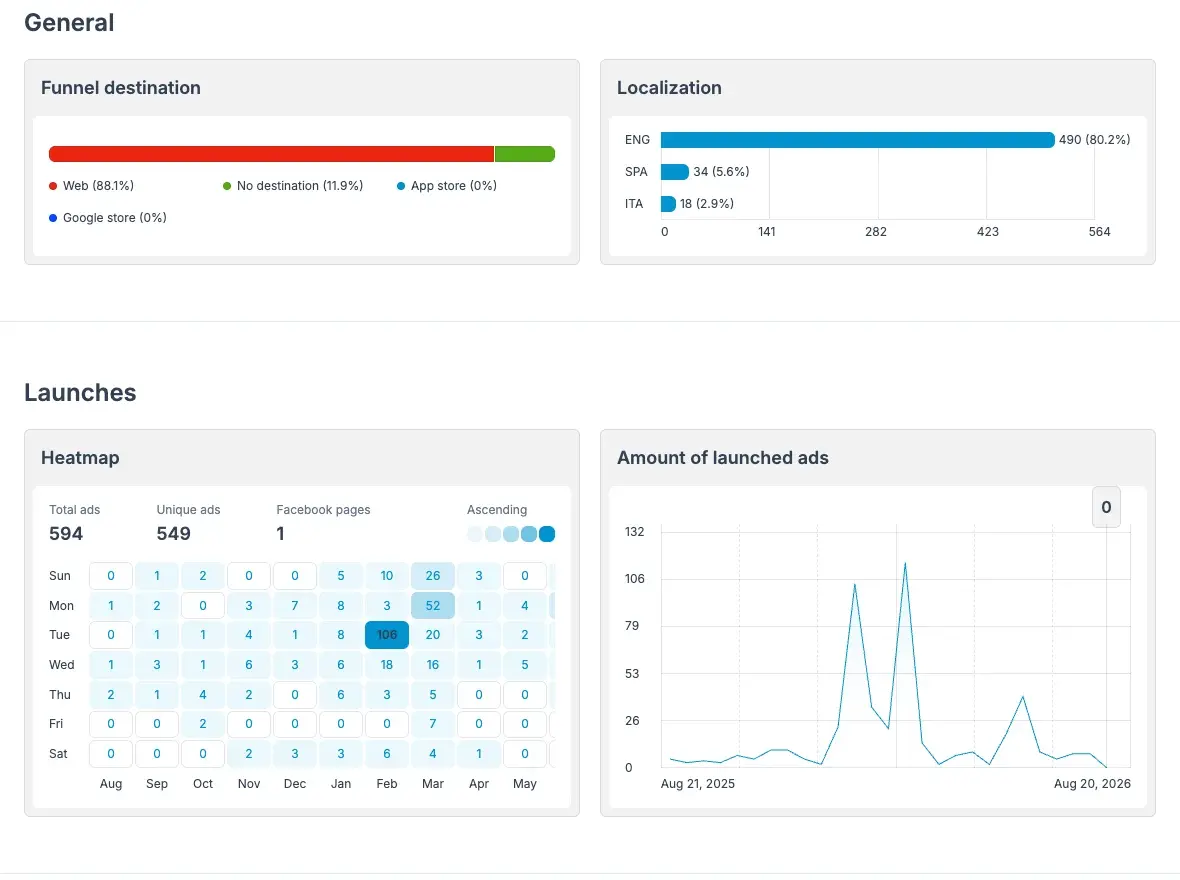 Tracker Analytics for Medicube: 594 ads, launch waves peaking at 106 new ads in a single day — testing rhythm made visible
From there, the production plan writes itself: match your format mix to the survivors (video-first, offer-statics alongside, carousels only for genuine catalogs) and score any creative you are tempted to copy with the 6-signal winner framework before you spend a cent reproducing it. For product-hunting on top of format intel, the e-commerce spy-tool playbook covers that workflow.
FAQ
Which ad format works best for beauty products on Facebook?
By live volume, video — 44–81% of currently running ads across our three beauty keyword sets (Aug 21, 2026). But survival rates tell a subtler story: statics live as long or longer than their share predicts, and the longest-running live ad in our serum set is a static. Produce video first; keep offer-statics in every test batch.
Do carousel ads work for skincare and beauty?
Almost never for single-product funnels: we found zero live carousels across 209 live beauty ads. The only carousels with long track records are multi-product catalog curations (the 774-day Japan With Love example). One hero product = skip the format.
How long do beauty ads stay live on Meta?
Briefly. 14% of live serum ads had passed 14 days and 2% had passed 30; in the wider collagen sample, 2.1% reached 30 days. Any beauty creative past a month is a top-2% survivor worth dissecting.
What ad format should a new beauty brand test first?
Short UGC-style video built on the surviving grammar — problem close-up, application, before/after, spoken hook — plus 2–3 offer-led statics per concept. That mix mirrors what the market's survivors actually are, rather than what feels premium in a creative review.
Conclusion
Measured, the beauty format debate ends in one sentence: video is the language, statics are the sleepers, carousels are extinct. The live pool is 44–81% video; the survival curve quietly favors sharp offer-statics; and not a single carousel was alive across three keyword sets on measurement day. None of this required opinions — just three filtered searches with format and longevity data, repeatable for any niche you buy in.
Your niche's census is 15 minutes away. Run the same format analysis — free in Adligator
Track a beauty brand and watch which formats it keeps alive
Related Reading
- Facebook Ad Format Analysis: What Spy Tools Reveal About Carousel vs Video vs Static Performance in 2026
- Facebook Ad Creative Trends 2026: What Spy Tools Reveal About Winning Formats, Hooks, and CTAs
- How to Build a Facebook Ad Swipe File That Actually Improves Your ROAS
- Facebook Carousel Ads Optimization: Card Sequencing, Storytelling, and Conversion Strategies for Media Buyers
