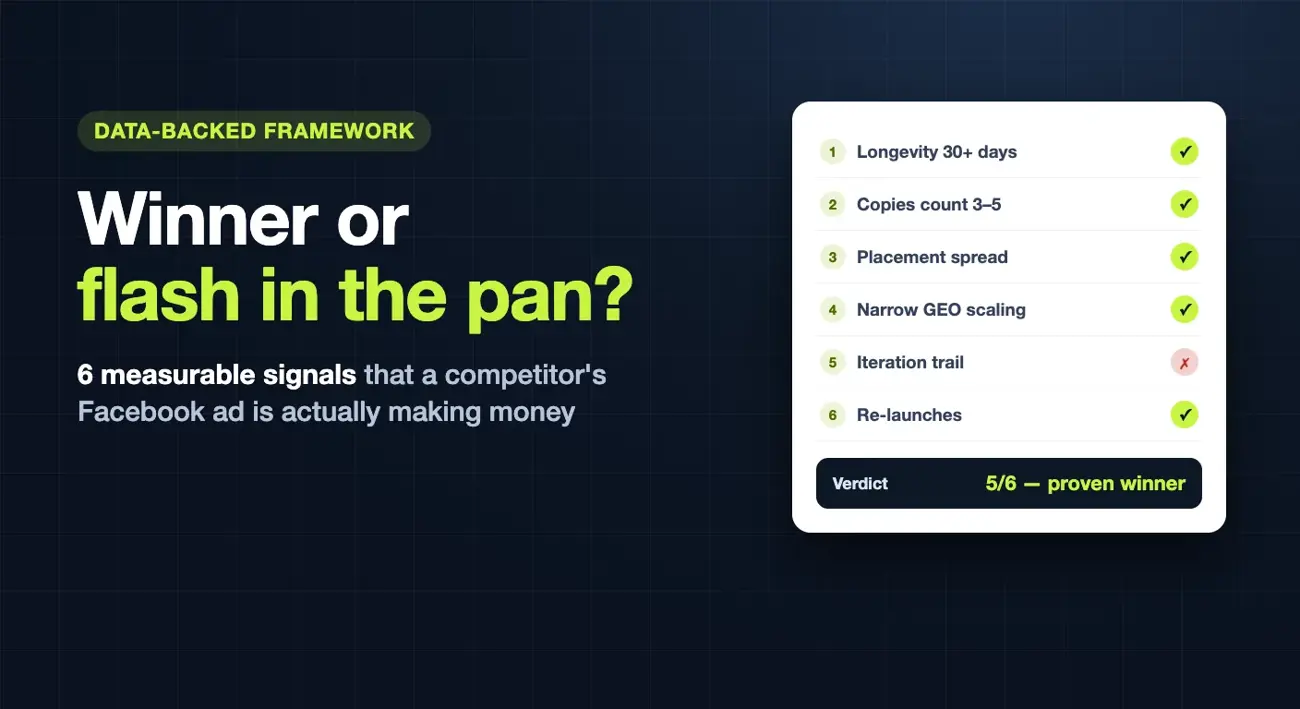
Scaled Winner or Flash in the Pan? 6 Data-Backed Signals a Competitor's Facebook Ad Is Actually Making Money
Every media buyer has done it: screenshot a competitor's ad, drop it in the team chat, write "this must be crushing it." The folklore version of due diligence adds one check — "it's been running 30+ days, so it's profitable" — and that single unsourced threshold has been copy-pasted across half the competitor-analysis guides on the internet.
Here is the problem: nobody publishing that threshold has measured anything. We have. In August 2026 we pulled survival data on 4,634 US Facebook ads across four commercial keyword sets and counted exactly how many were still alive at 7, 14, 30, 60 and 90 days. That dataset — plus copies counts, GEO patterns and launch histories from our library — turns "how to tell if a Facebook ad is performing well" from folklore into six signals you can verify in minutes.
Each signal below comes with its data anchor and, just as important, its false positive — the situation where the signal lies to you.
Why one screenshot of a competitor ad tells you nothing
A creative in isolation carries zero performance information. Meta's auction doesn't grade aesthetics; it grades outcomes you cannot see — CTR, conversion rate, margin behind the funnel. Two identical-looking ads can be a scaled money-maker and a day-old experiment that dies tomorrow.
What you can observe is the advertiser's behavior toward the ad: how long they keep paying for it, how many copies they run, where they expand it, how they iterate on it. Money leaves footprints. The six signals are those footprints, ordered by evidentiary weight.
Signal 1: Longevity — read it as a percentile, not a magic number
Longevity is the strongest single signal — advertisers do not keep paying for losers for months. But "30 days = profitable" is meaningless without knowing how rare 30 days actually is. From our measured sample (4,634 US ads across "free shipping", "collagen", "joint pain" and "credit card" keyword sets, Aug 15, 2026):
| Age reached | Share of ads still alive |
|---|---|
| 7+ days | 19.4% |
| 14+ days | 10.6% |
| 30+ days | 6.5% |
| 60+ days | 3.0% |
| 90+ days | 2.1% |
Read it as a ladder: roughly 4 in 5 ads die within a week. An ad at 14 days has outlived ~90% of its cohort; at 30 days it is in the top ~6%; at 90 days it is a 1-in-50 evergreen. And the ladder is market-specific — in the "free shipping" e-commerce set 8.9% of ads reached 30 days, while in the brutal "joint pain" nutra set only 0.8% did. The same 30-day badge is ordinary in one market and extraordinary in another; the full lifespan study breaks this down by niche and format — including the finding that video does not outlive statics (8.4% vs 8.3% 30-day survival in the same keyword set).
False positive: the zombie ad. A creative can show hundreds of days simply because nobody at a dormant advertiser bothered to switch it off. Always check the page's recent launch activity before trusting a lone long-runner: a 200-day ad on a page that launched nothing for six months is neglect, not performance.
Signal 2: Copies count — variants are budget votes
When an advertiser duplicates one creative into multiple ads, that is a budget allocation decision — they are buying more auction inventory for the same asset. Copies count is the closest observable proxy to "they scaled it."
But copies only mean something multiplied by age. Two live examples from the same day (Aug 21, 2026):
- A David Outwear jacket creative: 3 copies, 1,745 days running. Three copies of a five-year survivor is a sustained budget vote.
- A casino-style creative targeting a 21-country European basket: 25 copies, 2 days old. That is not scaling — that is a launch spray, and history says most of it will be gone within the week.
The working threshold: 3–5 copies on a creative that already has 14+ days is a strong vote. Double-digit copies on a days-old creative proves only that someone clicked "duplicate" enthusiastically.
False positive: fresh test batches — and increasingly, machine-made ones. Since Advantage+ creative enhancements went default-on in mid-2026, libraries contain variant clusters no human deliberately created. Age is your filter: AI noise doesn't survive.
Both numbers are on every ad card. Check any ad's real running time and copies count — free in Adligator
Signal 3: Placement spread — Instagram added = confidence
Where an ad runs is a decision trail. A creative confined to one placement is usually a controlled test; a creative that appears across Facebook feed, Instagram, Audience Network and Messenger after weeks live has been promoted to workhorse duty — advertisers widen distribution of what converts and quarantine what doesn't.
The pattern to look for is spread over time: an ad that started narrow and gained placements is telling you its metrics earned the expansion.
False positive: auto-placements. Advantage+ campaigns switch every placement on from day one, so full coverage on a fresh ad is a default, not a decision. Placement spread only carries signal when combined with age — full spread and 30+ days is meaningful; full spread on day two is noise.
Signal 4: GEO pattern — narrow scaling beats 200-country spray
GEO targeting separates conviction from harvesting:
- Conviction: a small, stable GEO set held for weeks. An advertiser paying for the same 2–5 countries month after month has unit economics that work there.
- Harvesting: the 200-country blast. Our library is full of creatives targeting 150–232 countries at once — the strategy is to let Meta's delivery find the cheapest qualifying clicks anywhere on earth. It can be profitable, but it tells you nothing about any specific market, and copying such an ad into your single-GEO campaign imports none of its economics. We dissected this blast pattern separately — worldwide sprays are their own playbook with their own math.
False positive: treating a spray's longevity as GEO-level proof. A 232-country ad alive for a year proves the global funnel works; it does not prove the offer converts in your market. Check whether the advertiser also runs narrow campaigns in the GEO you care about — that is the real conviction signal.
Signal 5: The iteration trail — small edits mean structured testing
Winners rarely appear alone. Scan a strong advertiser's library sorted by longevity and you will see families: one base creative surrounded by variants with a changed hook, price badge, first frame or headline — most short-lived, a few accumulating days. That trail is what disciplined testing looks like from the outside, and the surviving family member is the test's published answer.
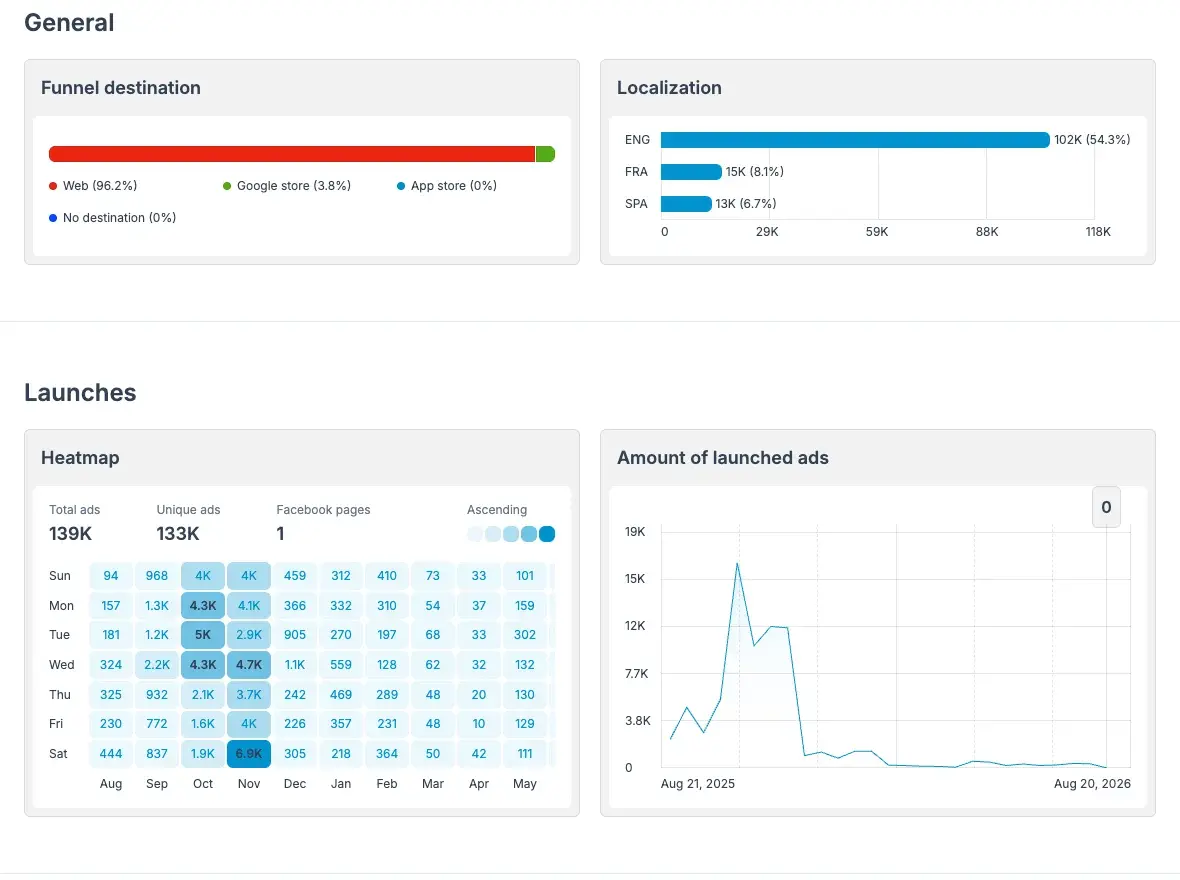 Tracker Analytics turns signals 5 and 6 into one chart: launch cadence, iteration waves and what survived them
A tracker's Analytics tab shows the trail at advertiser scale. The extreme case is Temu: 139K library ads on one page, with a launch curve that spiked to ~17,000 new ads in a single two-week window (October 2025) and then collapsed to a trickle through 2026. Against that firehose, fewer than 2% of the page's ads ever pass 90 days — the survivors are the distilled output of the most expensive creative test on Meta. The same chart on a normal-sized competitor shows you their testing rhythm: when they iterate, how hard, and which weeks produced the creatives that stuck. Study the survivors' anatomy — hook patterns that repeat across winners are catalogued here.
False positive: variant clouds nobody chose. Post-Advantage+, some "iterations" are machine mutations. A human iteration trail has direction — successive variants keep the surviving element. A machine cloud is directionless variation that all dies together.
Signal 6: Re-launches — the strongest quiet signal
The subtlest and most underrated signal: the same creative coming back. When an ad pauses and relaunches — same asset, new flight — someone reviewed the numbers and decided it earned a second run. Nobody relaunches losers. Seasonal comebacks (a creative that returns every Q4) are the strongest version: proof it made money twice.
The catch: Meta Ad Library shows each flight as a separate ad with a fresh start date, so a relaunched 300-day veteran looks like a newborn. Cross-flight history — cumulative active days, past flights, gaps — only exists in libraries that track ads over time. It is also why folklore's "check the start date" method silently misses the best ads in most niches.
False positive: the everything-rerun. Some advertisers relaunch their entire back catalog each season as a matter of housekeeping. A relaunch is only a vote when it is selective — a few creatives return, the rest stay retired.
Scoring a real ad in 5 minutes (walkthrough)
Let's score one live ad end-to-end, exactly as you would in the app: David Outwear's "Best Selling Jackets — Up To 50% Off Storewide" static (checked Aug 21, 2026). Filters used: page search + sort by longest running, then fromActiveDays=14 and minCopiesCount=3 to cross-check the field.
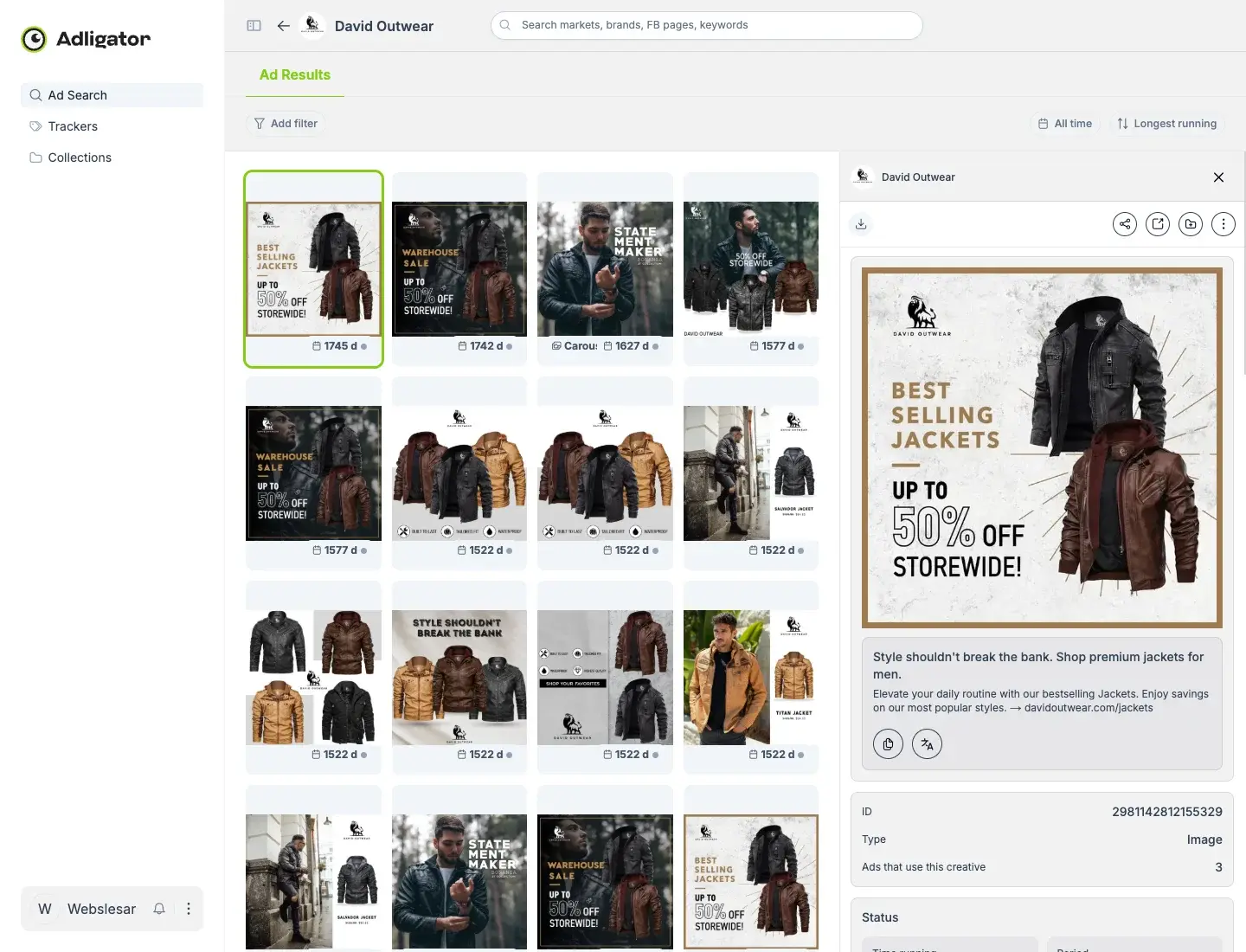 The worked example: one panel shows longevity (1,745 days), copies (3 ads use this creative), CTA and landing domain
- Longevity: ✓ 1,745 days — running since July 2021. The 90-day bar admits 2.1% of ads; this one is in a different universe.
- Copies: ✓ 3 ads use this exact creative — a sustained budget vote, not a spray.
- Placements: ✓ Distributed beyond a single surface over its lifetime.
- GEO: ✗ 232 countries — this is a worldwide blast, so the GEO signal contributes nothing about any single market. One honest miss.
- Iteration trail: ✓ The page's longevity-sorted library is a textbook family: "Warehouse Sale" and "Best Selling" variants at 1,742 and 1,577 days, and a cohort of eight 1,522-day siblings launched as one batch.
- Re-launches: ✓ Those same-day sibling cohorts are batch re-flights of proven assets — selective, structured, repeated.
Verdict: 5/6 — a proven winner worth dissecting for hook, offer framing and landing flow (with the GEO caveat: validate the offer in your market before copying). Total time: under five minutes, most of it reading. The same six checks in Meta Ad Library are simply unavailable: no lifespan counter, no copies count, no cross-flight history — you would be estimating spend from thumbnails instead of reading recorded behavior.
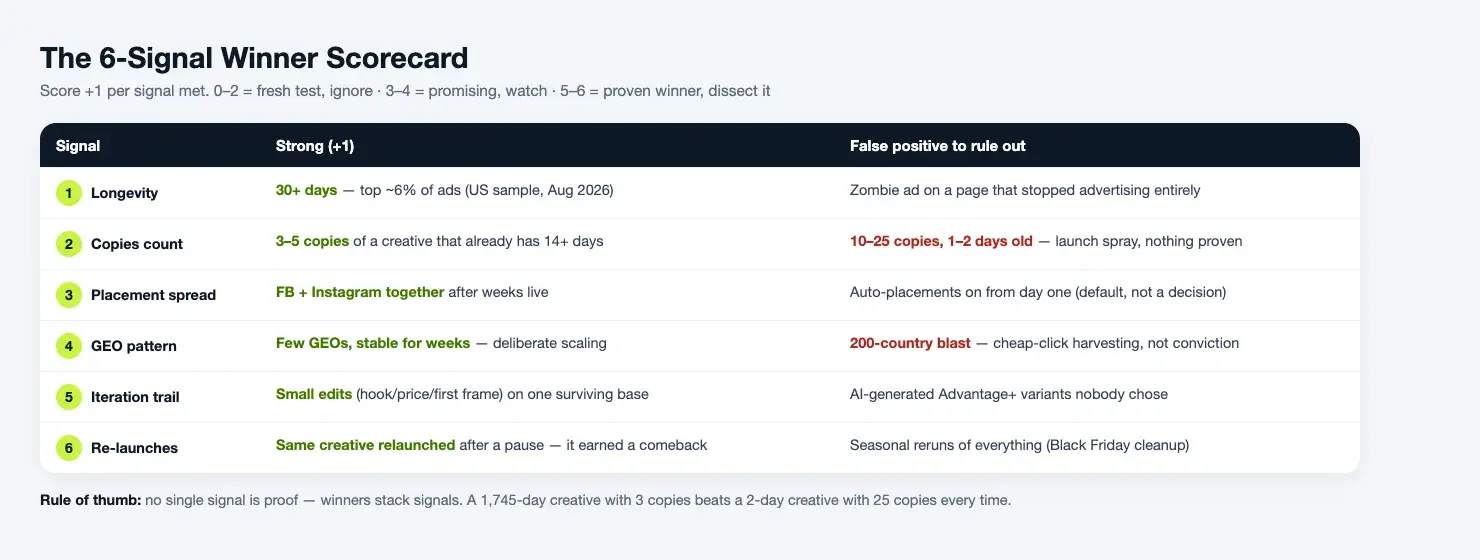 The scorecard: +1 per signal, and a false positive to rule out for each
FAQ
How long does a Facebook ad need to run to be considered successful?
Read longevity as a percentile, not a number. In our Aug 2026 US sample (4,634 ads), 6.5% were alive at 30 days and 2.1% at 90. Past 30 days an ad is top-decile for its market; past 90 it is a certified evergreen. Calibrate to the niche — the 30-day bar admits 8.9% of e-commerce "free shipping" ads but only 0.8% of "joint pain" ads.
Can a 3-day-old ad be a winner?
It can become one — but nothing is proven yet, since ~80% of ads die within a week. The exception worth noting: a fresh ad that is a re-launch or close iteration of a long-running creative inherits its parent's track record.
Do many copies of one ad always mean it is profitable?
No. Copies must be multiplied by age. 3–5 copies of a 14-day-plus creative is a budget vote; 25 copies launched two days ago is a spray that has proven nothing yet.
How do I check how long a competitor's ad has been running?
Meta Ad Library shows a start date per flight and resets it on every relaunch. To see cumulative active days, copies count and launch history you need an ads library that tracks ads over time — in Adligator both numbers sit on every ad card, and any page can be sorted by longest running.
Conclusion
"Is this competitor ad performing well?" is answerable — just not from a screenshot. Money leaves six footprints: days survived, copies funded, placements widened, GEOs held, iterations directed, comebacks earned. Each one has a false positive, which is exactly why winners are identified by stacking signals, never by folklore thresholds. The data infrastructure for all six checks already exists; the five-minute scorecard above is the whole method.
Ready to score your first ad? Check any ad's real running time and copies count — free in Adligator
Set a tracker on the advertiser and let the winners surface themselves
Related Reading
- How to Estimate Competitor Facebook Ad Spend Using Spy Tools and Ad Library Data
- Facebook Ad Creative Lifespan: How Long Do Ads Last Before Fatigue? Data-Backed Guide (2026)
- How to Build a Facebook Ad Creative Testing Framework Using Competitor Spy Data
- Competitor Landing Page & Funnel Analysis: How to Decode Facebook Ad Funnels
