The Competitor Ad Scorecard: Grade Any Facebook Ad in 5 Minutes Before You Swipe It
Every media buyer has one: a swipe file full of gorgeous competitor ads that never turned into a winning test. The ad looked incredible, you rebuilt it for your product - and it died in three days along with $300 of test budget.
The problem isn't your taste. It's that saved is not vetted - and aesthetics are the signal that correlates least with performance.
This competitor facebook ad analysis template fixes the vetting step: 12 observable signals, 100 points, clear thresholds for swipe, watch, or skip. No opinions about "scroll-stopping visuals" - only proof signals you can read from public ad-library data. Copy the table, grade your next ten saves, and watch half of them fail.
Why most swipe files are graveyards (saved is not vetted)
Ask what your last ten saved ads have in common. In most swipe files the honest answer is: they looked good. That's a criterion for a moodboard, not for media buying. The signals that actually predict whether an ad structure is worth stealing are boring and numeric:
- Somebody paid to run it for weeks. Nobody funds a losing ad for 60 days. Longevity is the closest thing to a public ROAS signal that exists.
- Somebody duplicated it. Advertisers clone winning creatives into new ad sets and campaigns. Copies are a deliberate scaling action, not an accident.
- Somebody expanded it. New GEOs and new placements cost money. Expansion means the unit economics survived contact with reality.
None of those signals are visible when you screenshot an ad from your feed, and Meta Ad Library shows only a raw list - no days-active history, no duplicate count, no longevity sort. That's why most swipe advice stops at "save ads you like": the grading data wasn't accessible. It is now. (Building your collection process from scratch? Start with our Facebook ad swipe file guide and come back for the vetting layer.)
The 12 signals that separate proven ads from pretty ads
The scorecard groups 12 signals into three families, weighted by how hard the signal is to fake:
- Longevity signals (40 points) - has this ad survived the market's daily profitability test?
- Scale signals (35 points) - did the advertiser put more money behind it?
- Offer & funnel signals (25 points) - is there a real, coherent selling machine underneath?
Aesthetics score zero points. If an ad is beautiful AND proven, wonderful. But beauty without proof is exactly the trap the scorecard exists to catch.
Longevity signals: active days, first seen, still running
The heaviest family, because it's the hardest to fake: every extra day of delivery costs the advertiser real money.
Signal 1 - Days active (0-20 points). The core metric. In our measured US ecommerce sample, only ~6.5% of ads survive past 30 days, which makes 30+ days elite territory: 30+ days = 20 points, 14-29 = 12, 7-13 = 6, under 7 = 0.
Signal 2 - Alive past the test window (0-10). Is the ad still running AND older than a week? 10 points if yes; 5 if it stopped recently after a long run (still worth studying); 0 if it's too new to judge - a 2-day-old ad simply hasn't been tested by the market yet.
Signal 3 - Page consistency (0-10). Check the advertiser's other ads: does the page have several other 30+ day runners? A page full of long-lived ads belongs to a team that kills losers fast - so everything they keep running carries signal. 10 points for 3+ other long runners, 5 for one, 0 for none.
Here's what longevity screening looks like when the data is sortable - "free shipping" ads in the US, filtered to 30+ active days, sorted by longest running:
 Ads with 2,000+ days of delivery surface instantly. Meta Ad Library can't sort by any of this.
Scale signals: copies count, GEO spread, placements
Longevity says "it survived". Scale says "they doubled down". Copies count is the second-heaviest signal in the entire rubric.
Signal 4 - Copies count (0-15). How many ads use this exact creative and text? Duplicating a creative into new ad sets is the standard scaling move, so 5+ copies = 15 points, 3-4 = 10, 2 = 5, single = 0.
Signal 5 - GEO spread (0-10). Deliberate multi-market expansion (3-10 countries) = 10 points. One or two countries = 5. Indiscriminate 50+ country blasts = 5 as well: often a cheap-reach strategy, not proof the ad wins anywhere specific.
Signal 6 - Placement coverage (0-10). 3+ placements = 10; two = 6; one = 3. Advertisers restrict placements when performance is fragile.
Signal 7 - Landing page investment (0-5). A dedicated product page or funnel = 5, a generic homepage = 2, a dead link = 0 and an automatic skip. (Yes, this one lives between scale and funnel - dedicated pages cost money, and that spend is a scale decision.)
Offer and funnel signals: CTA, landing page, prelander
The last 20 points test whether there's a coherent selling system - because you're not swiping pixels, you're swiping a machine.
Signal 8 - CTA-funnel match (0-4). Shop Now to a product page, Learn More to an advertorial, Sign Up to a lead form: 4 points for a clean match, 2 for a mismatch (Learn More straight to a product page), 0 for No Button.
Signal 9 - Concrete offer (0-4). "49% off + free shipping, code TREAT15" = 4. "Discover our collection" = 0. Concrete offers are what actually gets copied into your test.
Signal 10 - Hook you can name (0-4). Can you say in one sentence what the first two lines do (problem call-out, social proof, price anchor, curiosity gap)? If you can't name the mechanism, you can't rebuild it - 0 points.
Signal 11 - Compliance smell test (0-4). Sketchy TLDs (.xyz, .top, .shop burners), medical claims, fake countdown timers = 0-1 points. Clean domain and claims = 4. A high-scoring ad on a throwaway domain is often a cloaked funnel - study it, don't imitate it.
Signal 12 - Creative-copy coherence (0-4). Does the creative show what the copy sells? Winning systems align; Frankenstein ads (stock video + unrelated promise) fall apart when you copy the structure.
The scorecard template (copy it)
| # | Signal | Max | What to check |
|---|---|---|---|
| Longevity — 40 pts | |||
| 1 | Days active | 20 | 30+ days = 20 · 14-29 = 12 · 7-13 = 6 · <7 = 0 |
| 2 | Alive past test window | 10 | Running now AND >7 days old = 10 · long run, recent stop = 5 · too new = 0 |
| 3 | Page consistency | 10 | Advertiser has 3+ other 30-day ads = 10 · one = 5 · none = 0 |
| Scale — 35 pts | |||
| 4 | Copies count | 15 | 5+ copies = 15 · 3-4 = 10 · 2 = 5 · single = 0 |
| 5 | GEO spread | 10 | Deliberate 3-10 countries = 10 · 1-2 = 5 · 50+ spray = 5 |
| 6 | Placements | 10 | 3+ placements = 10 · 2 = 6 · 1 = 3 |
| 7 | Landing investment | 5 | Dedicated page/funnel = 5 · homepage = 2 · dead link = 0 |
| Offer & funnel — 25 pts | |||
| 8 | CTA-funnel match | 4 | CTA fits destination = 4 · mismatch = 2 · no button = 0 |
| 9 | Concrete offer | 4 | Number + mechanism + urgency = 4 · vague = 0 |
| 10 | Nameable hook | 4 | You can name the mechanism = 4 · "it's pretty" = 0 |
| 11 | Compliance smell | 4 | Clean domain & claims = 4 · burner TLD / fake scarcity = 0-1 |
| 12 | Creative-copy coherence | 4 | Creative shows what copy sells = 4 · mismatch = 0 |
| Total | 100 |
These weights are our editorial rubric - built from the survival and scaling patterns in our measured breakdowns of winning ads - not an industry standard. Adjust them to your vertical, but keep the family order: longevity > scale > polish.
Every field in this table is a column or filter in Adligator. Open a free account and the scoring data - days active, copies count, GEO count, placements, CTA, landing URL - sits on one screen per ad.
Scoring walkthrough: grading one real ad end to end
Let's grade a real ad found with the exact search from the screenshot above (keyword "free shipping", GEO US, 30+ days active, 3+ copies): a leather iPhone wallet-case video by Covrse.com.
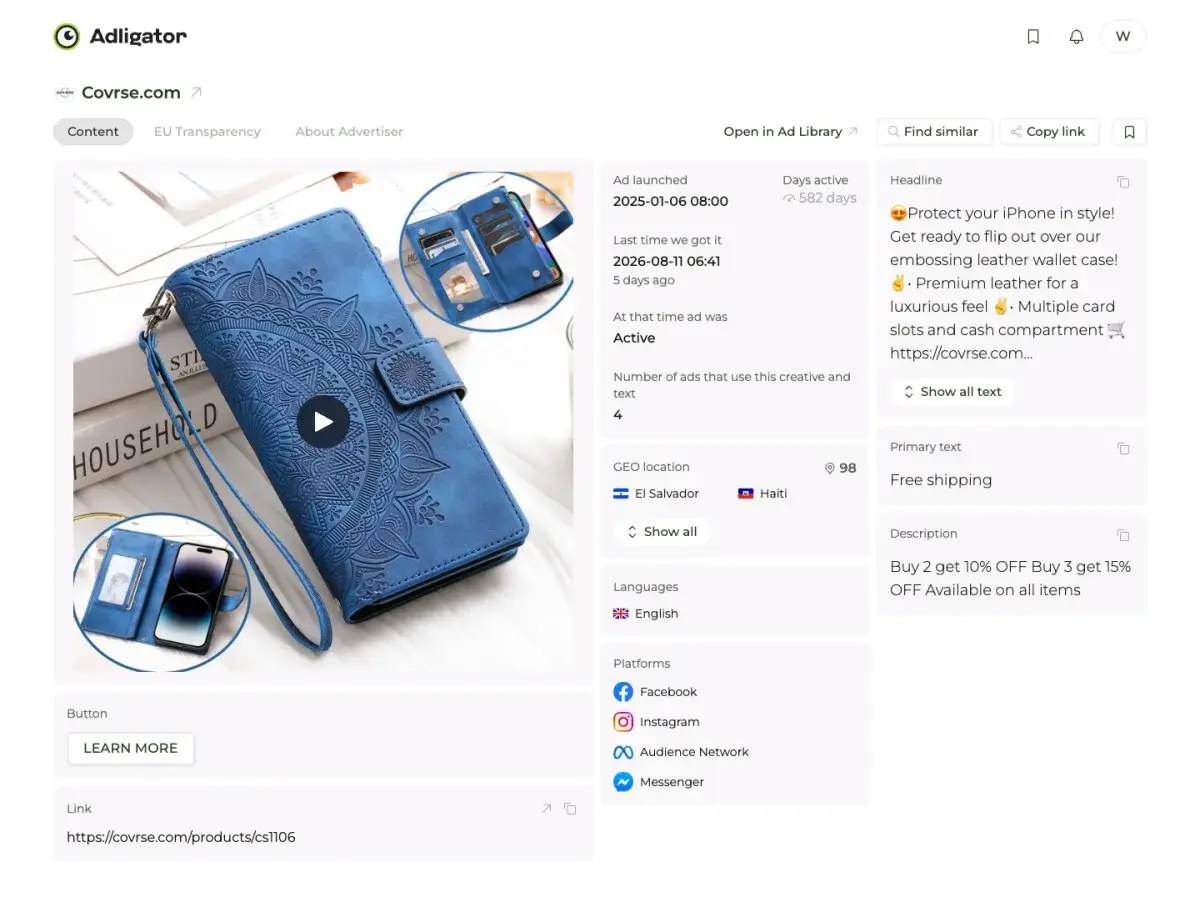 582 days active, 4 copies, 98 countries, CTA, landing URL - the whole scorecard readable from one detail page
Walking the rubric top to bottom (data as of 2026-08-16):
- Days active: 582 → 20/20. Launched January 2025, last seen active August 11, 2026.
- Alive past test window: running for over a year and a half → 10/10.
- Page consistency: Covrse.com has 6 more ads with 30+ active days in the last two months → 10/10.
- Copies count: 4 ("Number of ads that use this creative and text: 4") → 10/15.
- GEO spread: 98 countries → 5/10. This is the cheap-reach pattern - broad low-CPM distribution, not targeted scaling.
- Placements: Facebook, Instagram, Audience Network, Messenger → 10/10.
- Landing investment: dedicated product page (covrse.com/products/cs1106) → 5/5.
- CTA-funnel match: Learn More pointing straight at a product page → 2/4.
- Concrete offer: "Buy 2 get 10% off, buy 3 get 15% off" + free shipping → 4/4.
- Nameable hook: feature-benefit stack ("premium leather, card slots") - nameable but weak → 2/4.
- Compliance: clean .com store, no wild claims → 4/4.
- Coherence: video demonstrates exactly the case being sold → 4/4.
Total: 86/100 - swipe it. Not because it's beautiful (it isn't, particularly), but because the market has funded this exact structure daily for 19 months and the advertiser keeps cloning it.
Now the contrast - a polished car-seat-cushion video ad by Roveck, launched two days ago:
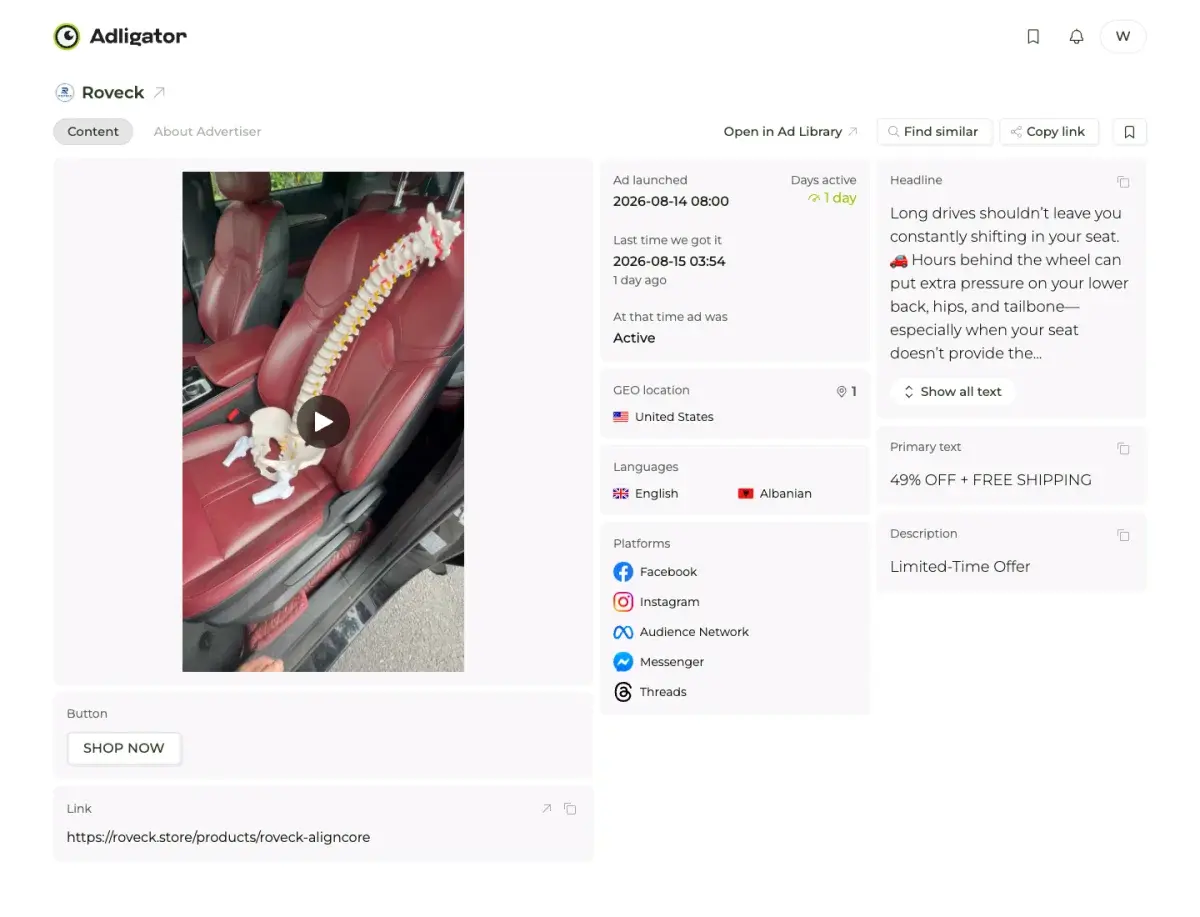 Better production than the 86-point ad. One day of delivery. Zero proof.
Score it honestly: days active 1 → 0. Too new to judge → 0. No other long runners on the page → 0. No copies → 0. Single GEO → 5. Five placements → 10. Dedicated product page → 5. CTA match → 4. Concrete offer → 4. Nameable hook → 4. Compliance: .store burner-style domain → 2. Coherence → 4.
Total: 38/100 - skip for now. The production quality is higher than Covrse's; the proof is zero. This is exactly the ad your eyes want to swipe and your budget shouldn't. Re-score in two weeks - still running with copies, it graduates.
Reading the score: swipe, watch, or skip
- 70-100 - Swipe & test now. Market-proven structure: extract offer, hook and funnel into a brief this week.
- 40-69 - Watchlist. Promising but unproven. Re-score in 7-14 days: rising days-active and new copies move it up; disappearance answers the question for free.
- 0-39 - Skip. The market hasn't confirmed whatever you liked about it. Let the advertiser spend their own money finding out.
Two rules keep the system honest: score before you save, and date every score - a 55 from March means nothing in August. When a 70+ ad graduates into your own account, cross-check frequency benchmarks for your vertical so you scale it without burning the audience.
From scorecard to creative brief
A graded swipe file feeds a production pipeline instead of a mood folder:
- Batch-score weekly. Set a tracker on your niche keyword and grade the new long-runners it surfaces - scoring from live filters takes minutes.
- A-grades become briefs. Translate each 70+ ad into a one-page brief with our creative brief from ad-spy data template.
- Niche-level evidence beats single ads. The tracker's Analytics tab shows which headlines, CTAs and media mix dominate the whole keyword - so you grade each ad against what the niche actually rewards:
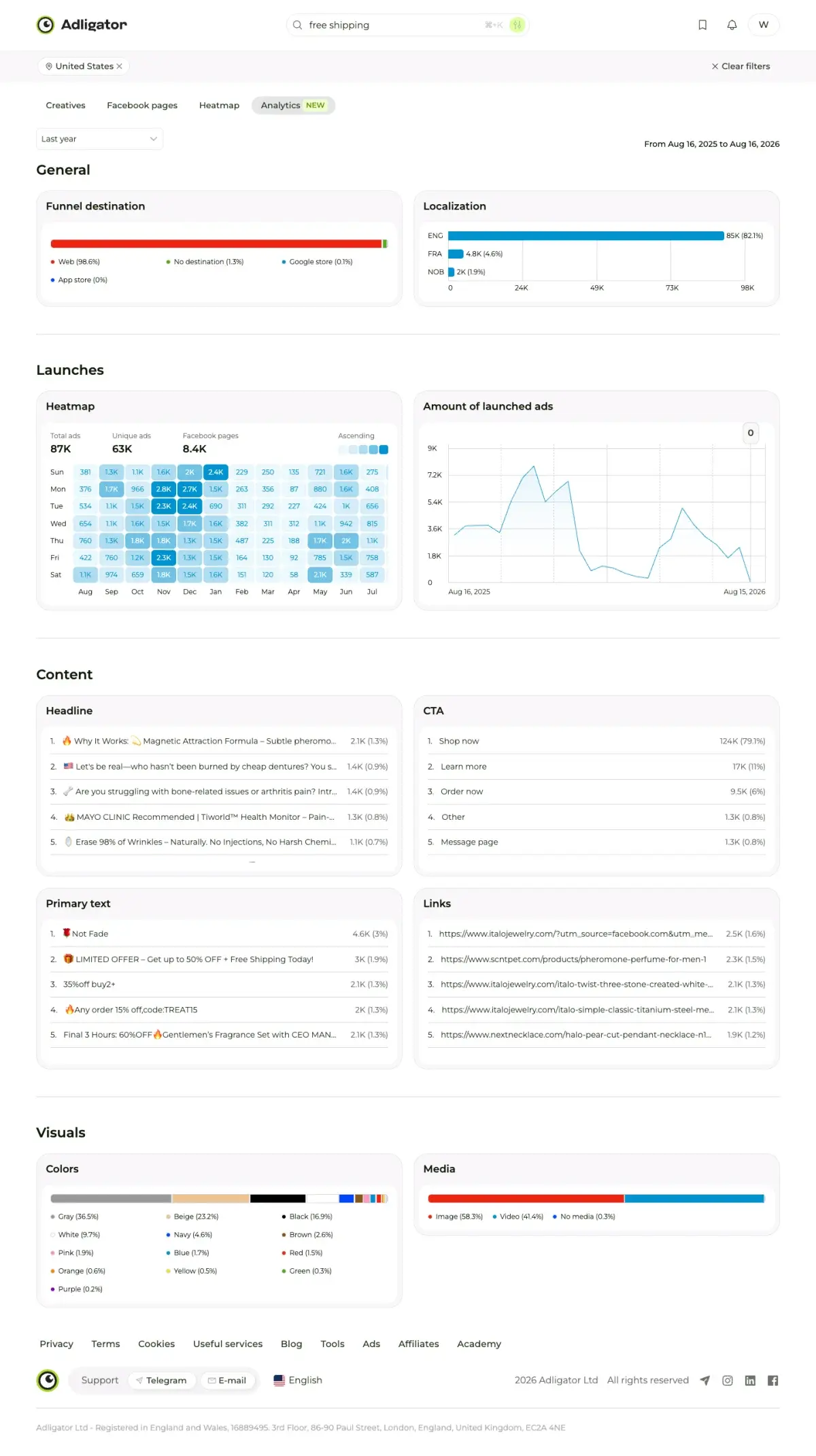 Tracker Analytics for "free shipping" (US), one-year window: 87K ads, launch heatmap, top headlines and CTA distribution - context for every score you assign
FAQ
How do I know if a competitor Facebook ad is actually working?
You can't see ROAS, but you can read proof: days active (30+ is top-7% territory in our measured US ecommerce data), copies count (3+ means deliberate scaling), GEO and placement expansion, and whether the page maintains other long runners.
How long should an ad run before it counts as a winner?
Under 7 days means nothing - most ads die inside the first week. From 14 days of continuous delivery an ad counts as validated; 30+ days puts it in the proven tier that only ~6.5% of ads reach.
Is copying competitor ads legal?
Studying public ads is what Meta's Ad Library exists for. Copying assets - images, video, trademarked copy - violates copyright and Meta policy. The scorecard extracts the proven structure, which you rebuild with your own product, claims and creative.
How many ads should be in a swipe file?
30-50 scored ads beat 500 unvetted saves. Enforce the threshold: only 70+ scores earn a save, 40-69 go to a dated watchlist, everything else gets closed without ceremony.
Conclusion
The scorecard turns swiping from a taste exercise into a five-minute grading routine: 40 points for surviving the market, 35 for the advertiser doubling down, 25 for a coherent selling machine - zero for being pretty. An 86-point wallet-case ad with mediocre production beats a 38-point cinematic masterpiece, because one of them has 582 days of receipts.
Grade your first 10 competitor ads free - open Adligator: days active, copies count, GEO spread and every other scorecard field is already on the screen.
Related Reading
- How to Reverse-Engineer Winning Facebook Ad Creatives: A Step-by-Step Framework
- Facebook and Instagram Reels Ads Analysis: How to Spy on Competitor Short-Form Video Creatives
- How to Analyze Facebook Ad Creatives by GEO and Vertical: A Data-Driven Approach for Media Buyers
- How to Write High-Converting Facebook Ad Copy Using Competitor Spy Data: A Copywriting Framework for Media Buyers
