Meta Just Handed Everyone the Same Q4 Playbook — Your Edge Is What It Leaves Out
On July 27, Meta launched its 2026 Holiday Insights Center — a free hub of consumer research, benchmarks, and step-by-step guidance for the holiday season. Within days, every marketing publication had summarized it, and every advertiser in your auction had access to the same numbers you did.
That last part is the problem. The Meta Holiday Insights Center is genuinely useful — and strategically neutral. When 10 million advertisers receive identical benchmarks, those benchmarks stop being an advantage and become the table stakes. Your Q4 edge has to come from somewhere Meta doesn't publish: what your specific competitors did last season, when exactly they did it, and what survived.
This guide covers both halves — a fair summary of what Meta released, then the three questions the hub structurally cannot answer, each answered with real creative data from last Q4.
What Meta actually released on July 27 and who it's aimed at
Credit where due: the release is substantive. The Holiday Insights Center bundles survey results from nearly 15,000 holiday shoppers across 18 countries, platform benchmarks, and the Meta Holiday Playbook: Small Business Edition — a step-by-step advertising guide explicitly aimed at companies with limited time, staff, and marketing experience.
The headline numbers: Meta expects the 2026 holidays to drive more than $1.4 trillion in retail spend, with online shopping growing 2.5x faster than in-store. And there's one genuinely important calendar fact — Black Friday falls on November 27 in 2026, leaving only 28 days until Christmas, roughly a week less than most years. Meta's timing advice follows directly: have your ads live by mid-October so the delivery system finishes learning before auction prices peak.
If you're a two-person shop running your first holiday campaign, read the playbook. It will save you from unforced errors. That framing — small businesses with no time — also tells you who it under-serves: anyone whose problem isn't "how do holiday ads work" but "how do I beat the other advertisers in my auction."
Why shared benchmarks are table stakes, not an advantage
A benchmark tells you what the average advertiser experiences. But you don't compete against an average — you compete against the specific brands bidding on your audience. Three properties make universally distributed data strategically inert:
- Everyone adjusts to it simultaneously. If Meta tells all advertisers to launch by mid-October, mid-October gets more crowded, and the advantage of launching by mid-October shrinks the moment it's published.
- Aggregates hide the distribution. "$1.4 trillion in spend" contains zero information about whether your competitor scales in week one of November or waits for Black Friday week.
- It describes shoppers, not rivals. Consumer survey data answers "what do buyers want?" — a product question. Auction outcomes are decided by "what are competing advertisers doing?" — an intelligence question the hub doesn't touch.
The practical conclusion isn't to ignore Meta's data. It's to treat it as the floor everyone stands on, then build the layer nobody else has: a reconstruction of your competitors' last Q4, which — unlike a survey — is sitting in public ad archives waiting to be read. That's the layer the rest of this article builds, using the "black friday" keyword slice of the Adligator library as the worked example.
The three questions Meta's guide structurally cannot answer
Meta's hub can't tell you about your competitors for a simple reason: it aggregates everything into averages by design. Three questions decide Q4 outcomes, and all three require per-advertiser, per-creative, per-date data:
- When did your competitors actually launch last Q4 — not when Meta recommends launching?
- Which of their creatives survived the whole season, and which died in week two?
- What did their offer look like at peak — after the testing was done?
Each has a concrete answer in last season's data. Let's take them in order.
Question 1: when did your competitors actually launch last Q4?
An ad's start date plus its days-active count reveals exactly when an advertiser turned on last year's holiday push — the single most copyable piece of competitor intelligence there is. Aggregated across a keyword, it becomes a launch calendar for the whole season.
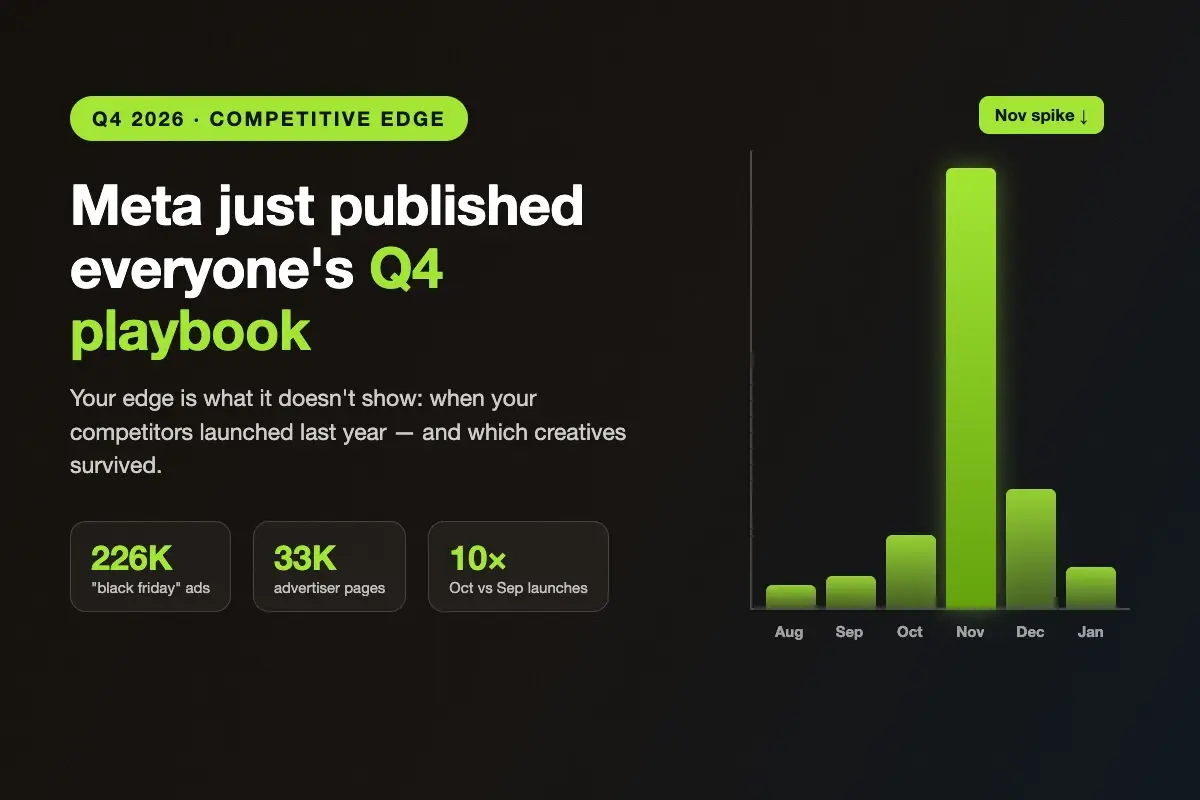
Here's the full-year picture for creatives matching "black friday" in the Adligator library — 226K ads from 33K advertiser pages:
 One year of 'black friday' creative: 226K ads from 33K pages, with the launch curve spiking in late November
Read the launch heatmap columns left to right and the timeline writes itself. August cells sit under 130 launches per bucket. September climbs into the low hundreds. October jumps to 700–3,200 per cell — roughly 10x September. November explodes to 16K–32K per cell, and the daily launch line spikes above 100K new matching creatives around Black Friday itself. By January it's all over.
The strategic detail is in the October column. Thousands of "black friday" creatives were already live a full month before the event — and hundreds entered the library as early as September 2025. Those aren't premature sales; they're creative tests, run while CPMs are still cheap, so that only proven hooks enter the expensive November auction. That's the behaviour worth copying, and it's invisible in any benchmark — you can only see it by reading your own vertical's seasonal launch data.
Question 2: which creatives survived the whole season, and which died in week two?
Launch timing is half the picture. The other half is survival: of everything your competitors tested, what did they keep funding?
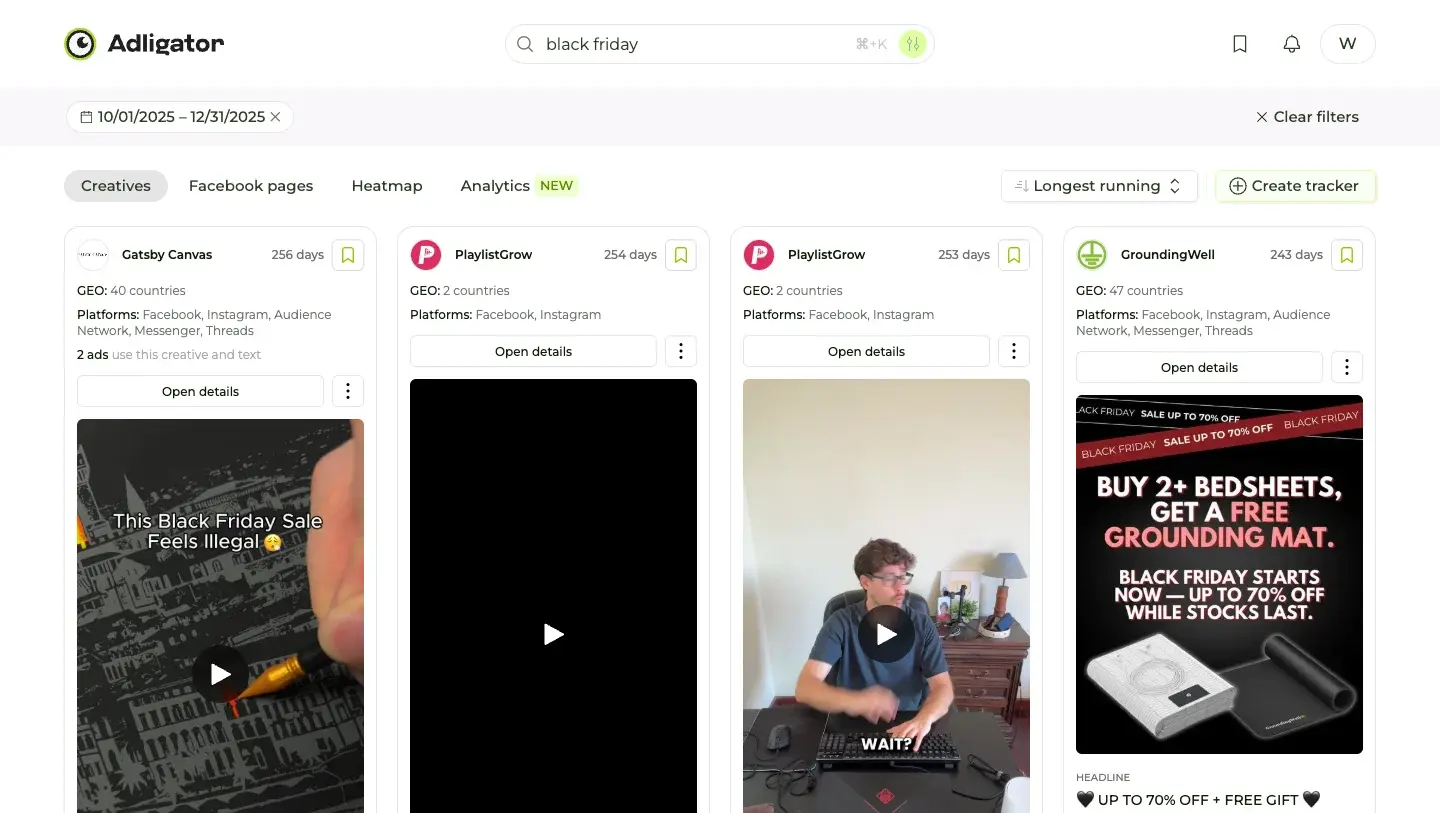
Filter last season's "black friday" creatives to launches between October 1 and December 31, 2025, sort by longest running, and the season's report card appears:
 Q4 2025 'black friday' creatives sorted by survival: the leaders ran 243–256 days
The two ends of the distribution tell different stories:
- The casualties. A clothing ad launched October 14 lasted 1 day. A supplement ad launched October 17 lasted 4. A watch brand's November 6 creative barely registered a day of delivery. This is the invisible majority — tests that failed fast and disappeared. Every one of them is an angle your competitor already paid to invalidate.
- The survivors. A scratch-art brand's November 22 video ran 256 days. A Spotify-promotion service's November 6 creative ran 254. A shapewear advertorial launched October 23 ran 241. A French AI tool's October 16 "Black Friday 50% OFF" creative ran 215.
Notice what the survivor list implies: several of last season's most durable holiday creatives are still running in summer 2026. The sharpest example is a hair-dye brand whose December ad — copy literally reading "Sale Ends Today!" — has now run 222 days across 219 countries. Whatever you think of the ethics of permanent urgency, the mechanism is worth understanding: for some advertisers, "Black Friday" stopped being a date and became a permanent hook pattern.
For your planning, the survivors are a curated swipe file with proof of spend attached — the closest public data gets to "this worked." The breakdown method for winning ad examples applies directly to this list.
Question 3: what did the offer look like at peak, not at launch?
The third blind spot is offer construction. Benchmarks tell you shoppers respond to discounts — thanks. What you actually need is the anatomy of the offers that carried your competitors through the season: discount depth, bundle structure, gift-with-purchase, guarantee stack.
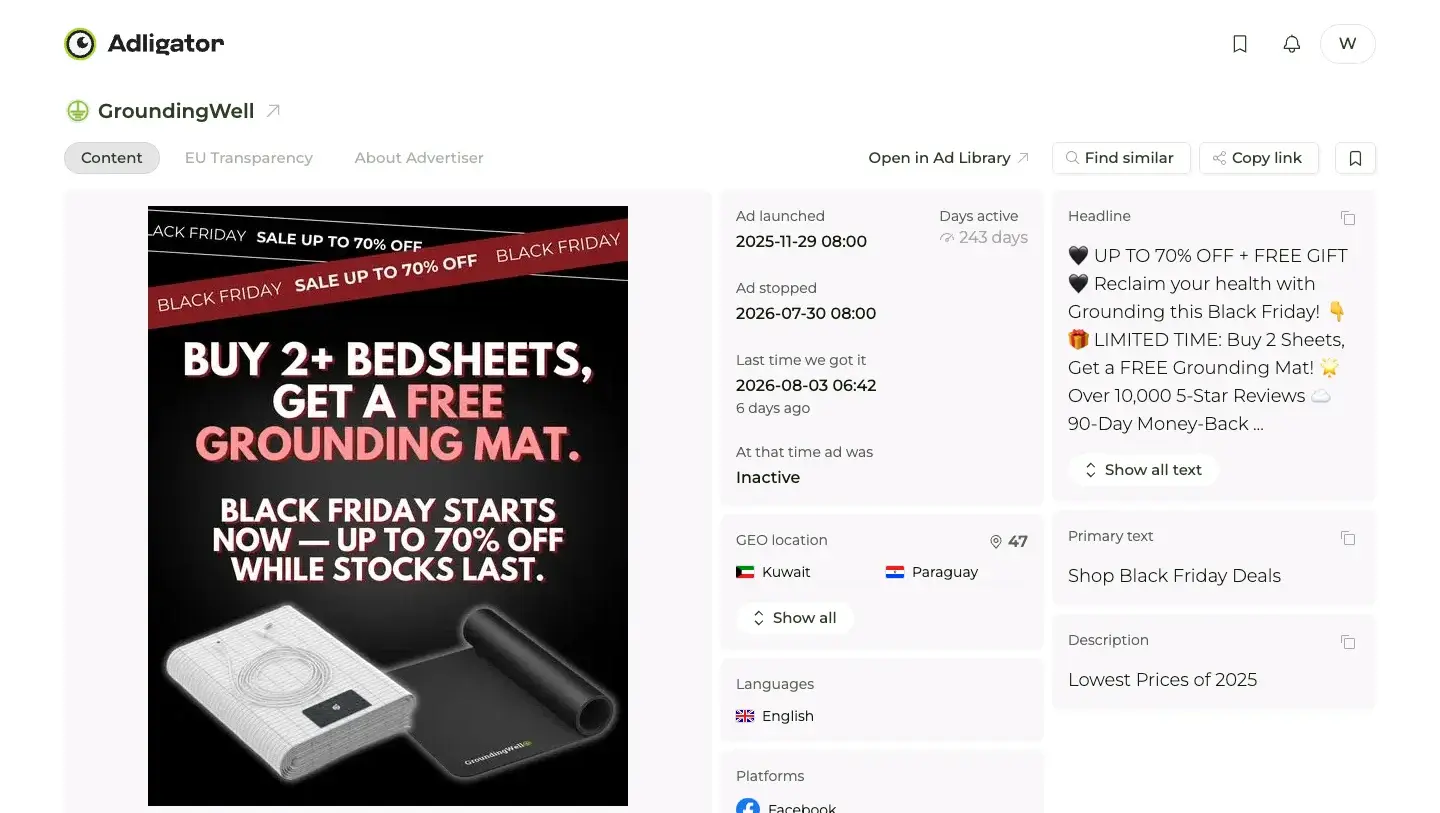
The ad detail view reconstructs it. Here's the season winner from the grounding-sheet brand above:
 The full offer anatomy of a season winner: launched Nov 29, retired July 30, 243 days later
Everything a Q4 offer brief needs is on one screen: launched November 29, retired July 30 — 243 days of funded delivery. The offer stack: up to 70% off + buy-2-get-a-free-mat + 10,000 reviews cited + 90-day money-back guarantee. Compare that with the other survivors — 40% off sitewide plus free add-ons at the scratch-art brand, a $10 flat-price deal at the shapewear brand, 60% off buy-one-get-one at a jewelry advertiser — and a pattern emerges: season winners led with stacked offers (discount + gift + guarantee), not bare percentages.
That's a creative brief you can hand to a designer today. No benchmark produces it.
Building your Q4 calendar backwards from competitor launch dates
Meta's calendar advice is one-size-fits-all. Yours should be reverse-engineered from when your actual competitors moved last year, adjusted for 2026's compressed 28-day BF-to-Christmas window. A dated plan:
August (now):
- List your 5 most dangerous competitors and pull their last-Q4 timeline: first seasonal creative, scaling date, peak-offer structure.
- Run the survivor sort on your main category keyword. Save every 100+ day survivor into a swipe file with notes on hook and offer.
September:
- Brief 2026 creative using the survivor patterns — angles first, offers second.
- Start low-budget creative tests while CPMs are calm, exactly as last year's October launchers did — but a month earlier, because you now know they'll all be in the auction by October. Check per-country CPM benchmarks when choosing test GEOs.
October:
- Kill losing tests without sentiment — last season's data shows failed holiday creative dies within 1–5 days anyway.
- Have your proven creatives live by mid-October (Meta's advice and the observed advertiser behaviour agree here) so learning completes before November pricing.
- Set trackers on your five competitors so their 2026 launches surface daily from here to Christmas, instead of you discovering them in December.
November: you're not creating anymore — you're scaling what September proved, watching the daily feed for competitor pivots.
Want this table built for your niche instead of ours? Run last Q4's numbers on your vertical — the date-range search plus longest-running sort takes about two hours to turn into a complete competitor calendar.
FAQ
What is the Meta Holiday Insights Center and is it free?
It's a free hub Meta launched on July 27, 2026, combining consumer research, platform benchmarks, and a step-by-step Holiday Playbook aimed at small businesses. It includes survey data from nearly 15,000 holiday shoppers across 18 countries. Anyone can access it — which is exactly why it can't be a competitive edge on its own.
When should you start running Q4 Facebook ads?
Meta's own guidance says to have ads live by mid-October so the delivery system can learn before peak auction prices. Last season's library data supports an even earlier creative-testing start: "black friday" creative launches in October ran roughly 10x September's volume, meaning many advertisers were already testing hooks weeks before November.
How early do competitors launch their holiday campaigns?
Earlier than most buyers assume. In the Adligator library, hundreds of "black friday" creatives entered the library in September 2025, and October cells in the launch heatmap run 10–20x August levels. Several of last season's longest-surviving holiday ads launched in mid-October — a month before Black Friday.
How much do Meta CPMs rise during Q4?
It varies by market and vertical, and headline percentages are often invented — treat any single number skeptically. The reliable pattern is directional: auction prices climb from late October through Black Friday week and stay elevated until Christmas, which is why both Meta and practitioners recommend entering the auction with proven creative before the peak.
Can you see when a competitor's ad started running?
Yes. Both Meta Ad Library and ad intelligence tools show an ad's start date. In Adligator each card and detail page shows the launch date plus total days active, so you can reconstruct a competitor's entire Q4 timeline from last year — when they started testing, when they scaled, and which creatives they kept running.
Conclusion
Read Meta's Holiday Insights Center — it's a competent baseline, and the compressed 2026 calendar detail alone justifies the visit. Just be clear about what it is: information everyone has, which by definition decides nothing. This season's edge lives in the three questions the hub can't touch — when your competitors actually launch, which creatives they keep funding, and how their peak offers are built. All three are answerable today, from last season's public creative record, in about two hours of focused work.
The advertisers who did that homework last August are the ones whose "failed tests" you never saw and whose survivors you've been scrolling past all year.
Ready to do the two hours? Run last Q4's numbers on your vertical
Or start from the winners: pull the seasonal creatives that survived the whole season.
Sources consulted: Meta 2026 Holiday Insights Center launch coverage — Social Media Today (socialmediatoday.com) · Small Business Trends (smallbiztrends.com) · Unix Commerce (unixcommerce.com) · Adligator ad library (data capture 2026-08-09) · Meta Ad Library (facebook.com/ads/library)
Related Reading
- Winning Meta Ads Don't Start in One Country: What 200-Country Blasts Reveal About How Evergreen Creatives Actually Scale
- Meta's New 2–5% Location Fees Just Changed Your CPM Math
- Meta Advantage+ Shopping Campaigns: Complete Setup and Optimization Guide for eCommerce
- How Meta's Andromeda Algorithm Changes Ad Delivery in 2026: What Media Buyers Must Adapt
