
Meta's New 2–5% Location Fees Just Changed Your CPM Math
If you run Meta ads into Europe, your invoices are about to look different. As of July 2026, Meta location fees add a 2–5% surcharge on ads delivered in six countries — billed on top of your budget, not inside it. It's small per impression and easy to shrug off. At scale, it quietly reshuffles which GEOs are actually your cheapest.
This is a media buyer's breakdown, not a tax explainer. You'll get the exact rate per country, the effective-CPM math, why "just drop those countries" is usually the wrong move, and a 30-day plan — including how to watch whether your competitors are absorbing the fee or backing out.
What Meta's location fees actually are (and why now)
A location fee is a regulatory cost pass-through. Several governments charge a digital services tax on ad revenue earned in their market, and platforms have started billing that cost back to advertisers as a separate surcharge. Google has done this since 2020 and Amazon since 2024 — Meta is simply the last major platform to pass the cost through.
Three details matter for your numbers:
- It's based on delivery, not your location. The fee is triggered by where the impression is served, not where your business is registered. A US brand advertising into France pays the French rate on those impressions.
- It's billed separately, with VAT on top. The surcharge shows up as its own invoice line item, and VAT applies to the combined total.
- Campaign budget optimization ignores it. Meta's CBO spends against the budget you set; the fee is added afterward. That means your invoiced total can exceed the budget you entered — a reconciliation surprise if you're not expecting it.
The exact rates by country
Here's the current schedule. Treat it as the baseline for every GEO calculation below.
| Country | Location fee | Tier |
|---|---|---|
| Austria | 5% | Highest |
| Turkey | 5% | Highest |
| France | 3% | Mid |
| Italy | 3% | Mid |
| Spain | 3% | Mid |
| United Kingdom | 2% | Lowest |
Two countries sit at 5% (Austria, Turkey), three at 3% (France, Italy, Spain), and the UK at 2%. If your delivery is concentrated in Austria or Turkey, you feel this roughly two-and-a-half times harder than a UK-only campaign.
Watching competitor spend already? See which competitors keep advertising in each country — free on Adligator.
How the fee changes your effective CPM by country
The cleanest way to think about a location fee is as a bump to your effective CPM. Take your real CPM in a market, add the fee percentage, and that's what you're now paying to reach a thousand people there.
A rough worked example using public benchmark ranges:
- UK at roughly an $11 CPM, plus 2%, lands near $11.22 — about +$0.22 per 1,000 impressions.
- Austria or Turkey at a $9–10 CPM, plus 5%, adds +$0.45–0.50 per 1,000 impressions.
Per impression, that's noise. At volume, it compounds. An account spending $50,000/month on European delivery can expect roughly $1,000–$2,500/month in added fees, depending on the country mix. Weighted toward Austria and Turkey, you're at the top of that range; UK-heavy, the bottom.
The practical takeaway: the fee doesn't change your CPM ranking much, but it narrows the gap between a "cheap" Tier-1 market and a "moderate" Tier-2 one. If two GEOs were already close on cost-per-result, a 5% surcharge on one can flip which is genuinely cheaper — and that's a decision you can only make once you've recomputed each market with the fee baked in.
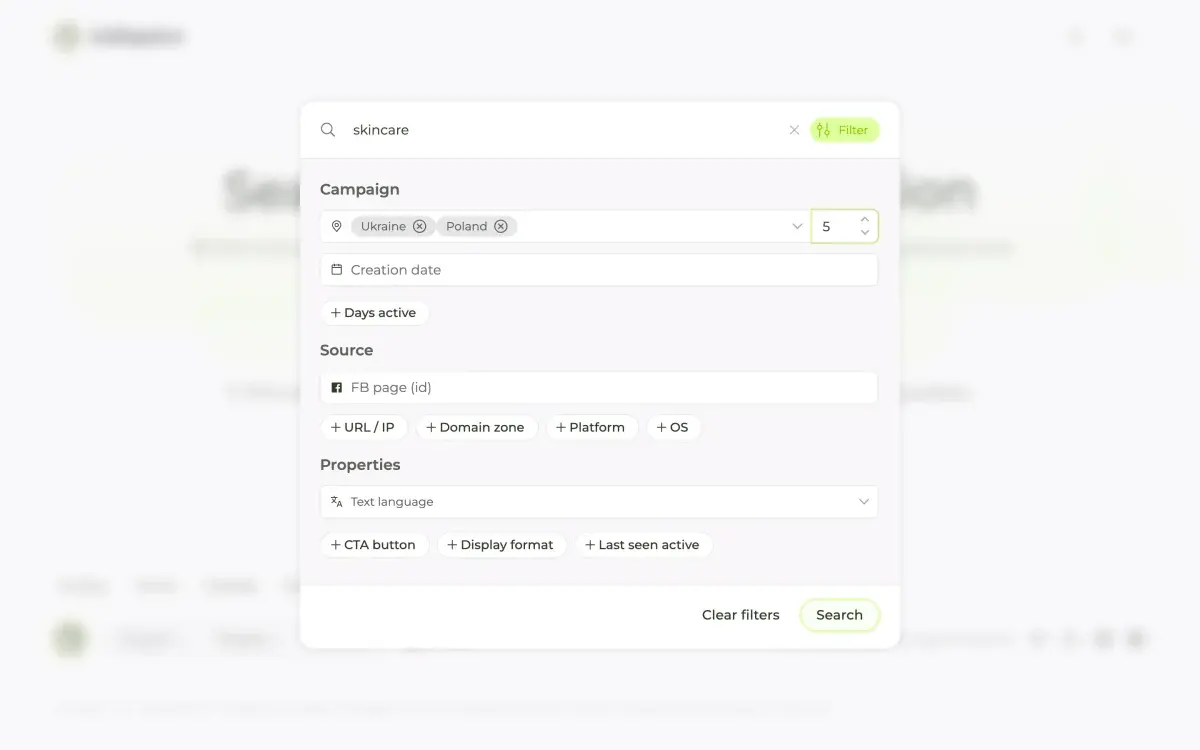 Adligator's GEO filter plus the max-countries cap isolates advertisers who deliberately concentrate on a short country list.
Why "just drop those countries" is usually the wrong move
The reflex is to exclude the fee markets. Resist it. A 2–5% surcharge is roughly the margin most accounts already leak through stale creative, loose audience exclusions, and untested bid strategies. Excluding Austria to dodge 5% while your creative is fatiguing costs you far more than the fee ever will.
These are also high-value markets. The reach and conversion value of the UK, France, Italy, and Spain typically dwarfs a few percentage points of surcharge. Blanket-cutting a profitable GEO to avoid a small fee is optimizing the wrong number.
The right frame: the fee is a forcing function to tighten the account, not a reason to abandon markets. Recover the 2–5% from the waste you already have, and keep the reach.
There's also a competitive angle to the exclusion reflex. If a chunk of advertisers over-react and pull out of Austria or Turkey, auction pressure in those markets eases — which can lower the underlying CPM enough to offset the very fee everyone panicked about. The disciplined buyers who stay put may end up paying less per result than they did before the change. That only works if you can see the market thinning in real time, rather than guessing at it.
How to re-plan GEO budgets around the surcharge
A tighter, evidence-based re-plan beats a panic exclusion. Work through it in this order:
- Recompute effective CPM per fee country. Add 5% to Austria and Turkey, 3% to France/Italy/Spain, 2% to the UK. This is your new baseline for every comparison.
- Re-rank GEOs by true cost-per-result, not CPM. A market with a slightly higher effective CPM but stronger conversion can still be your best GEO. Rank on the outcome, not the input.
- Trim within markets, don't cut them. Pause the weakest audiences, placements, and ad sets inside the fee countries rather than excluding the country wholesale.
- Claw back the margin elsewhere. Audit exclusions, placements, and bid strategies across the whole account. Recovering 2–5% of waste offsets the fee without losing reach.
- Reset budget expectations. Because CBO ignores the fee, adjust your monthly budget planning so the invoiced total — surcharge and VAT included — matches what finance expects.
The manual version of this is a spreadsheet: pull public CPM benchmarks, add the fee, and re-rank. That gets you a defensible plan. What it can't tell you is what everyone else is doing about the same fee — and that's where competitive signal earns its keep.
Watch what competitors do: spying on GEO shifts after the fee
A cost change is only half the story. The other half is behavior: are your competitors absorbing the fee and holding their markets, or quietly reallocating budget away from Austria and Turkey? You can't infer that from a benchmark table — you read it from what advertisers are actually running, country by country.
This is the moment manual research hits its ceiling. Recomputing your own CPMs is easy; seeing whether a competitor is still live in a 5% market is not something a spreadsheet can answer. That's the gap ad intelligence closes.
Start by filtering competitors' ads by delivery country. In Adligator, the GEO multi-select lets you pull every advertiser still running in the UK, France, Italy, or Spain — so you can see who's holding position in each fee market.
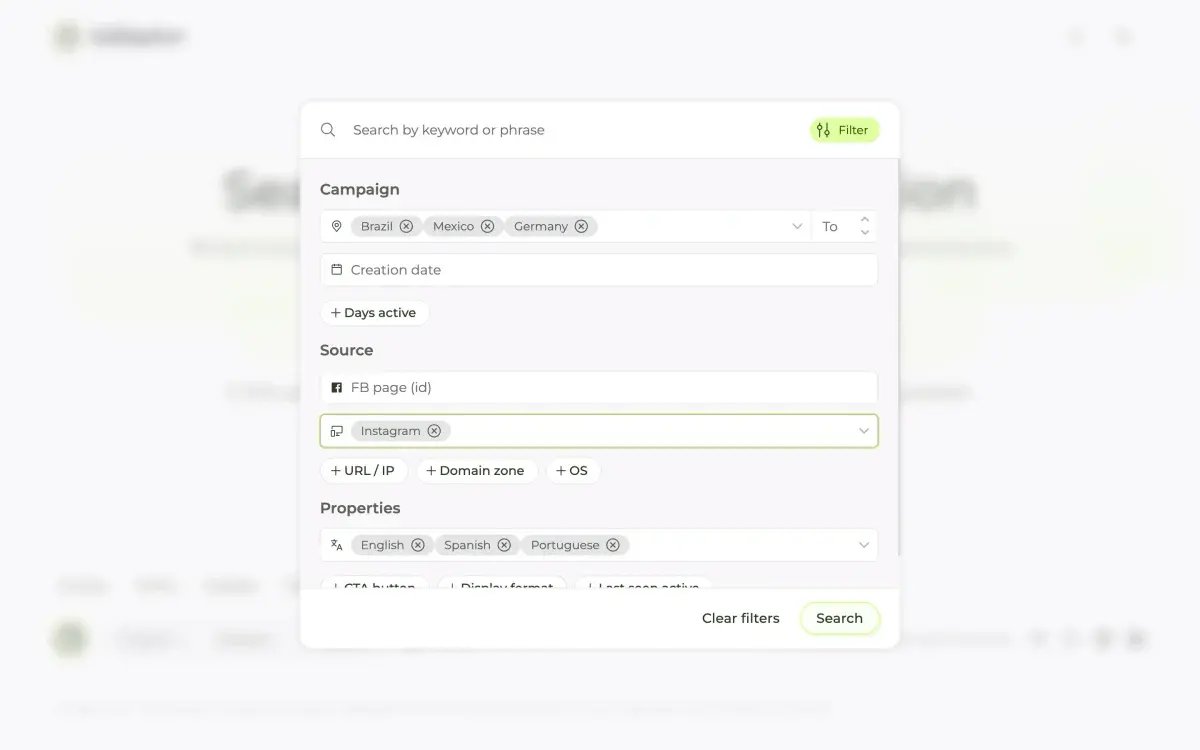 Filter competitors by delivery country to see who is still advertising in the fee-affected markets.
Then read the distribution over time. The Heatmap tab breaks a keyword's results down into a top-10 country ranking, and switching the window from "last year" to "last week" shows how that ranking is shifting right now. If a vertical's Austrian and Turkish concentration is thinning in the recent window while France and the UK hold, that's the market voting on how it's handling the 5% markets.
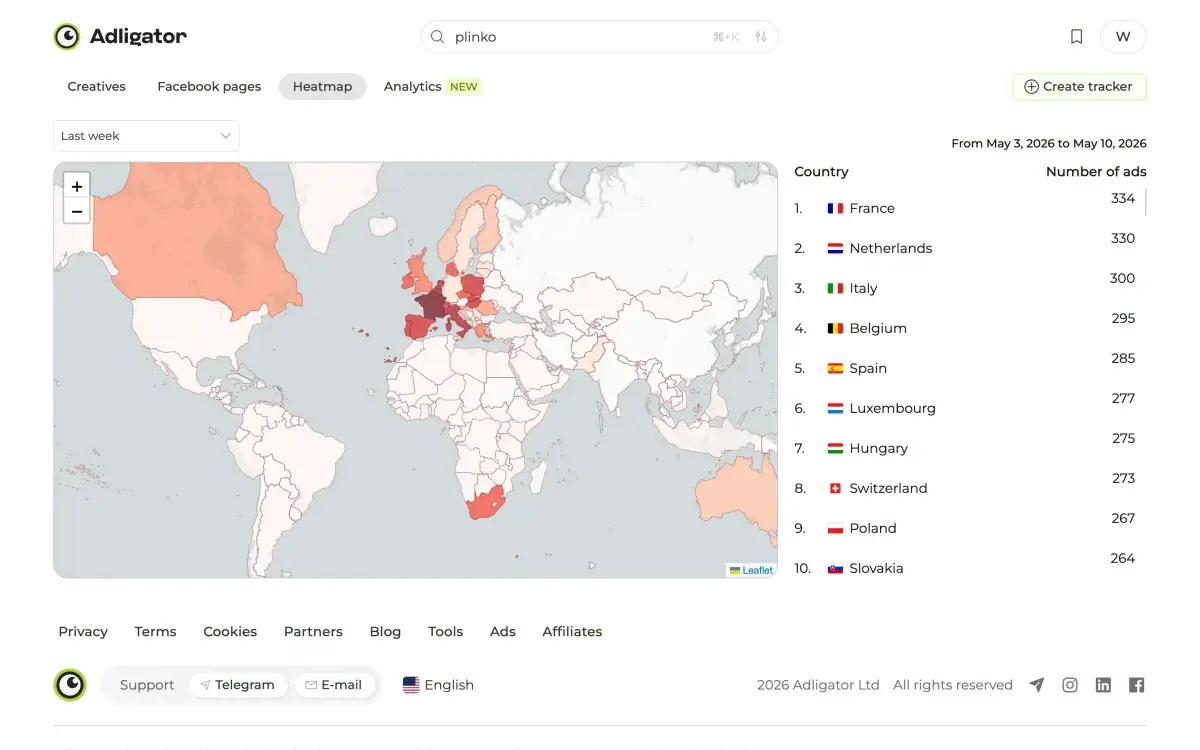 The Heatmap tab gives a country-by-country breakdown, so GEO shifts after the fee show up fast.
One more signal worth trusting: longevity. An ad that's been running 30+ days in a fee market is, by definition, still profitable after the surcharge — nobody pays weeks of tax-inclusive delivery on a losing creative. Sorting by days active tells you which offers survive the new math, not just which ones launched.
Your 30-day action checklist
- Pull last month's spend broken down by delivery country; flag exposure to Austria, France, Italy, Spain, Turkey, and the UK.
- Recompute effective CPM for each fee country using the rates above.
- Re-rank your GEOs by true cost-per-result with the fee included.
- Audit exclusions, placements, and bids to recover 2–5% of waste elsewhere.
- Set a competitor GEO watch on your top two verticals and check the Heatmap weekly.
- Decide absorb-vs-reallocate per country on evidence — never blanket-exclude a profitable market.
FAQ
Which countries have Meta location fees?
As of July 2026, six countries: Austria (5%), France (3%), Italy (3%), Spain (3%), Turkey (5%), and the United Kingdom (2%). The fee is based on where impressions are delivered, not where your business is registered.
Is the location fee added to my budget or taken out of it?
Added. It's billed separately as a line item on your invoice, with VAT applied on top, and campaign budget optimization does not account for it — so your invoiced total can exceed the budget you set.
Should I stop targeting these countries to avoid the fee?
Rarely. A 2–5% surcharge is usually far smaller than the reach and conversion value of these markets. It's almost always better to recover the margin elsewhere than to exclude a profitable GEO.
Conclusion
Meta location fees are not a crisis — they're a 2–5% nudge that rewards tight accounts and punishes lazy ones. Recompute your effective CPM per country, re-rank your GEOs on cost-per-result, and recover the surcharge from waste you already have instead of abandoning profitable markets. Then watch the market: the advertisers who hold their positions in the 5% countries are telling you those GEOs still pay.
The one thing a spreadsheet can't give you is that competitive read. Seeing who keeps running in each fee market — and where the country-by-country distribution is shifting — is exactly what turns "I priced the fee" into "I know how the market is reacting."
Ready to see where your competitors keep spending after the fee? Track competitor ads by country — free on Adligator.
Sources consulted: Meta Ads location-fee guidance and July 2026 changelogs (adsuploader.com, digitalapplied.com, almcorp.com); Facebook/Meta CPM-by-country benchmarks 2026 (lebesgue.io, adamigo.ai).
Related Reading
- Facebook Ad Performance Benchmarks by Vertical in 2026: CPM, CTR, and Creative Lifespan Data for Media Buyers
- Meta Just Handed Everyone the Same Q4 Playbook — Your Edge Is What It Leaves Out
- Media Buying Agency Pricing Models: How to Structure Fees for Facebook Ads Management (2026)
- Winning Meta Ads Don't Start in One Country: What 200-Country Blasts Reveal About How Evergreen Creatives Actually Scale
