
Media Buying Agency Pricing Models: How to Structure Fees for Facebook Ads Management (2026)
Pricing is the decision that shapes every other part of your agency. Get it wrong and you either burn out delivering $5,000 worth of work for $1,000, or you price yourself out of deals you should be winning. Most agency owners treat media buying agency pricing models as a one-time decision, but the best agencies revisit their pricing structure at least annually.
This guide covers the five main approaches to facebook ads management pricing, with real numbers, practical trade-offs, and decision frameworks you can apply immediately. Whether you are a solo freelancer taking on your first client or an established agency restructuring fees, you will find a model that fits your situation.
The goal is simple: a pricing structure that is profitable for you, fair for the client, and positions your agency for growth rather than a race to the bottom.
Why Pricing Is the Hardest Decision for New Agencies
New agencies almost always underprice. It feels safer. Lower prices mean more "yes" answers, fewer objections, and a faster path to revenue. But underpricing creates a cascade of problems that compound over time.
The underpricing death spiral:
- You charge too little to deliver quality work
- You take on too many clients to compensate
- Quality drops because you are spread thin
- Clients churn because results suffer
- You lower prices further to attract replacements
- Repeat until burnout
The opposite mistake — overpricing without justification — loses fewer deals than you think, but the deals it loses are usually the best clients. Premium clients expect premium pricing, but they also expect a clear explanation of what they are paying for.
The fundamental tension: your pricing communicates your value before your work does. A $500/month agency and a $5,000/month agency might deliver identical results, but the client's perception and expectations are entirely different.
The 5 Common Pricing Models Compared
Before diving into each model, here is the landscape. Every agency pricing structure falls into one of five categories, with variations and hybrids between them.
 The five main pricing models each serve different agency stages and client types.
| Model | Revenue Predictability | Incentive Alignment | Scalability | Best For |
|---|---|---|---|---|
| Flat Retainer | High | Low | Low | Small budgets, new agencies |
| % of Ad Spend | Medium | Medium-Low | High | Mid-large budgets |
| Performance-Based | Low | High | Medium | Confident agencies, ecommerce |
| Hybrid (Retainer + Bonus) | Medium-High | High | High | Most agency-client relationships |
| Project-Based | High (per project) | Medium | Low | Audits, setups, launches |
No model is universally best. The right choice depends on your agency's stage, client mix, risk tolerance, and competitive positioning.
Flat Monthly Retainer: When It Works and When It Doesn't
The flat retainer is the simplest model. The client pays a fixed monthly fee regardless of ad spend, campaign complexity, or results.
Typical ranges (2026 market rates):
- Solo freelancer, basic management: $500-$1,500/month
- Small agency, full-service: $1,500-$3,000/month
- Established agency, strategic: $3,000-$7,500/month
When it works:
- Client ad spend is under $5,000/month (percentage-based would be too small)
- Scope is clearly defined and unlikely to expand significantly
- You are building a portfolio and need predictable income
- The client values budget certainty
When it fails:
- Client ad spend grows significantly (you are doing 3x the work for the same fee)
- Scope creep is not managed — clients add "just one more thing" each month
- Results vary month to month, creating value perception problems during slow periods
How to protect yourself with retainers:
- Define scope explicitly: number of campaigns, creative iterations, reporting cadence
- Include an ad spend ceiling — if spend exceeds $X, the retainer adjusts
- Build in quarterly reviews where pricing can be renegotiated
- Never include unlimited revisions or unlimited creative production
Percentage of Ad Spend: The Industry Standard (and Its Problems)
The percentage model ties your fee directly to how much the client spends on ads. It is the most common agency fee structure for facebook ads management, especially for mid-to-large accounts.
Typical ranges:
- $5,000-$10,000/month ad spend: 18-20% management fee
- $10,000-$25,000/month: 15-18%
- $25,000-$50,000/month: 12-15%
- $50,000-$100,000/month: 10-12%
- $100,000+/month: 8-10% (often with minimums)
The advantages are obvious:
- Revenue scales naturally with client growth
- Industry standard means less client pushback
- Easy to calculate and communicate
- Rewards you for scaling the account successfully
The problems are less obvious but more dangerous:
- Conflict of interest. When your fee is tied to ad spend, you have a financial incentive to recommend higher budgets — even when reducing spend might be the right strategic move. Sophisticated clients know this and it erodes trust.
- The efficiency penalty. If you optimize so well that the client can achieve the same results with less spend, your fee goes down. You are literally punished for doing your job well.
- Revenue volatility. Clients cut budgets during slow seasons, promotions end, and ad accounts get restricted. Your revenue swings with factors outside your control.
- Minimum fee problem. A $5,000/month client at 20% generates $1,000/month — barely enough to justify your time once you factor in creative development, reporting, and strategy calls.
The clearest way to see this is to convert every structure back to an effective hourly rate. The work is the same; only the wrapper changes.
 The same 22 hours of work, three fee structures — only the effective hourly rate tells you which is profitable.
Run this calculation before you quote, not after the third month of losses. Below roughly $15,000/month in ad spend, percentage-only pricing rarely clears your delivery cost.
Mitigation strategies:
- Set a minimum monthly fee regardless of percentage calculation
- Use a sliding scale that decreases percentage as spend increases
- Pair with a performance bonus to partially decouple from spend
Performance-Based Pricing: Aligning Incentives
Performance-based pricing ties your compensation directly to results: CPA targets, ROAS thresholds, revenue generated, or leads delivered.
Common structures:
- Pay-per-lead: $10-$100 per qualified lead depending on industry
- Revenue share: 5-15% of attributed revenue
- CPA bonus: fee discount if CPA exceeds target, bonus if CPA beats target
- ROAS-based: base fee plus bonus for exceeding ROAS benchmark
When it works brilliantly:
- You have proven systems and confidence in your ability to deliver
- The client has proper tracking and attribution
- The product or service has strong unit economics
- Both parties agree on clear, measurable KPIs upfront
When it creates problems:
- Attribution is murky (common with long sales cycles or offline conversions)
- Client changes the product, pricing, or landing pages without warning
- External factors impact performance (seasonality, competition, platform changes)
- The client's backend (sales team, fulfillment) cannot handle the leads you generate
Critical rule: Never agree to pure performance-based pricing. Always include a base fee that covers your costs. Performance bonuses should be upside, not your entire income.
Hybrid Models: Retainer + Performance Bonus
The hybrid model combines a base retainer with a performance bonus. This is the model that most successful agencies eventually adopt because it addresses the fundamental tension between cost coverage and incentive alignment.
Recommended structure:
| Component | Amount | Purpose |
|---|---|---|
| Base retainer | $1,500-$3,000/month | Covers your time, tools, and overhead |
| Performance bonus | 10-15% of revenue above baseline | Aligns your incentives with client growth |
| Minimum commitment | 3-6 months | Ensures enough time to generate results |
How to set the baseline:
- Use the client's average monthly revenue from the past 90 days before engagement
- Alternatively, set a ROAS target: bonus triggers at 3x ROAS and scales from there
- Document the baseline clearly in the contract — disputes here end relationships
Example in practice:
- Base retainer: $2,500/month
- Client's baseline revenue from Meta ads: $30,000/month
- Performance bonus: 10% of revenue above $30,000
- Month 1: You generate $35,000 → bonus = $500 → total fee = $3,000
- Month 3: You generate $55,000 → bonus = $2,500 → total fee = $5,000
The client is happy because they only pay more when they make more. You are happy because your upside is uncapped and directly tied to the value you create.
Common mistakes with hybrid models:
- Setting baselines too low. If the baseline is easy to beat, the client feels like they are overpaying for bonuses on growth that would have happened anyway. Use conservative but honest baselines.
- Not capping the bonus period. Performance bonuses should reset quarterly or monthly. Avoid structures where a single great month generates an outsized one-time bonus that creates sticker shock on the invoice.
- Ignoring seasonality. A retail client's Q4 revenue will naturally spike. Build seasonal adjustments into the baseline so you are rewarded for genuine optimization, not calendar effects.
- Overcomplicating the formula. If the client needs a spreadsheet tutorial to understand their invoice, simplify the structure. The best hybrid models can be explained in two sentences.
Pitching the hybrid to clients:
Frame it as risk-sharing: "Our base fee covers the foundational work — campaign management, creative testing, weekly optimization, and reporting. The performance component means we only earn more when you earn more. We are literally betting on ourselves."
This framing works because it addresses the client's two biggest fears: paying for nothing (the base covers minimum deliverables) and misaligned incentives (performance bonus aligns your success with theirs).
Use Adligator to demonstrate value in client meetings — show competitive intelligence as part of your service
How to Price by Client Size and Complexity
Not all clients at the same ad spend require the same effort. A $10,000/month ecommerce account running 3 campaigns is fundamentally different from a $10,000/month multi-location business running 15 campaigns across 5 geo targets.
 Your pricing should scale with client complexity, not just ad spend.
Complexity factors that should increase your price:
- Multiple product lines or service categories
- Multiple geographic targets requiring separate campaigns
- High creative volume requirements (more than 8 new creatives per month)
- Complex conversion tracking (offline events, multi-touch attribution)
- Multiple stakeholders requiring separate reporting
- Regulated industries (finance, health, alcohol) with compliance requirements
- Multiple languages or markets
A practical complexity multiplier:
Start with your base price for a standard engagement. Then apply multipliers:
- Standard (1-3 campaigns, single market): 1.0x
- Moderate (4-8 campaigns, 2-3 markets): 1.3x
- Complex (9+ campaigns, 4+ markets): 1.6x
- Enterprise (custom structure, dedicated team): 2.0x+
If your base retainer for a standard account is $2,000/month, a complex account at the same ad spend should be $3,200/month.
When to Raise Your Rates
Every agency hits a point where their pricing no longer reflects their value. Recognizing that moment — and acting on it — separates agencies that grow from agencies that plateau.
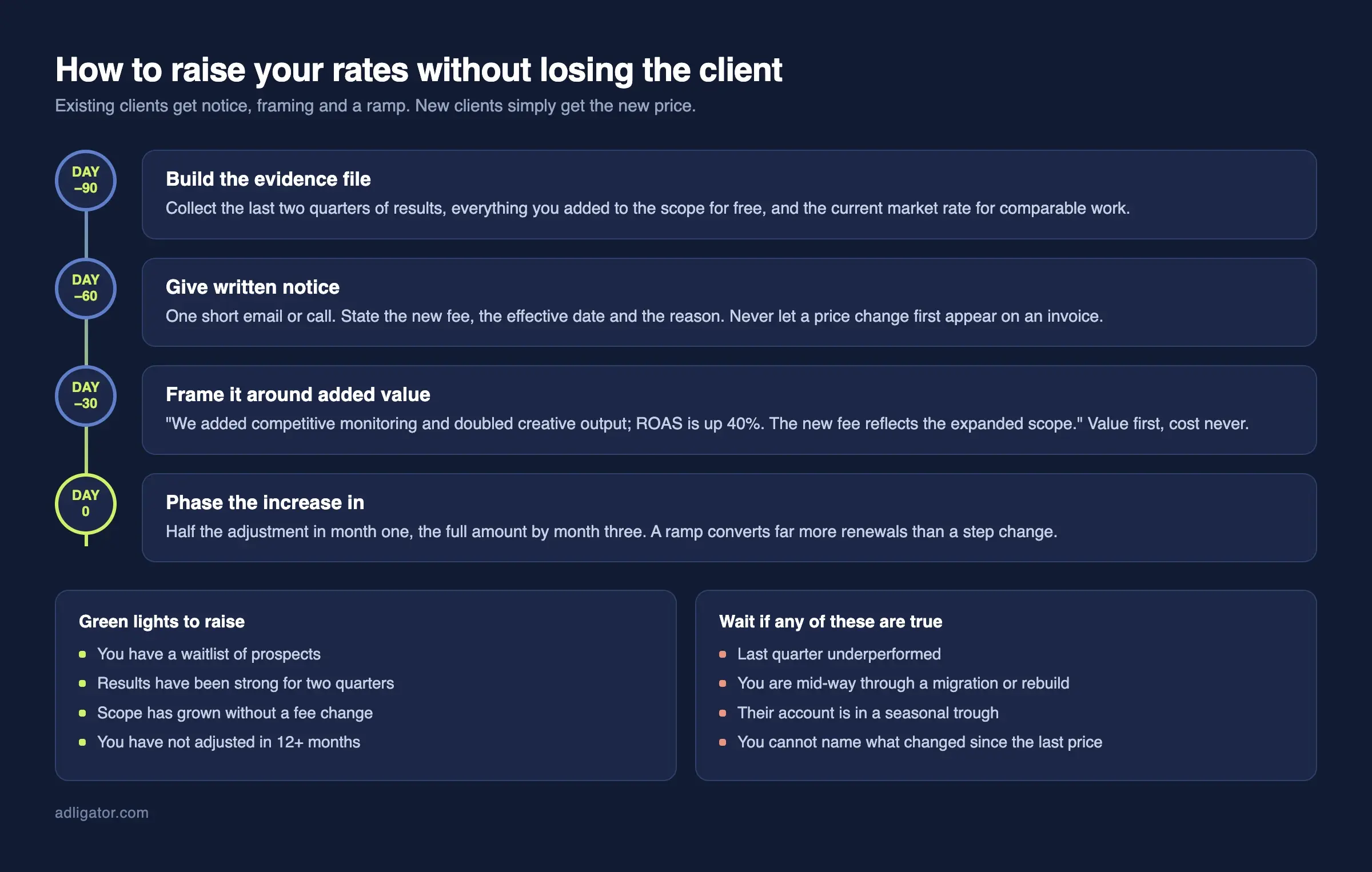 Rate increases should follow a predictable pattern tied to results and market conditions.
Signals it is time to raise rates:
- You have a waitlist of prospective clients
- Your current clients consistently get strong results
- You are working more hours per client than your pricing justifies
- Your tools, team, or capabilities have expanded significantly
- Industry rates have increased (benchmark annually)
- You have not raised rates in 12+ months
How to implement increases:
For new clients: Raise immediately. New clients have no reference point for your old pricing.
For existing clients: Follow a three-step process:
- 60-90 day notice — Never surprise a client with a price increase
- Frame around value — "In the past 6 months, we have added competitive monitoring, expanded creative production to 12 variants per month, and your ROAS has increased by 40%. Our updated pricing reflects these expanded capabilities."
- Offer a transition — "For existing clients, we are implementing a phased increase: 50% of the adjustment in Month 1, the full adjustment in Month 3."
How much to raise: 10-20% annually is typical. If you have not raised prices in 2+ years, a 25-30% adjustment is justified but implement it gradually.
Pricing Transparency: What to Show Clients
Transparency builds trust, but many agency owners confuse transparency with oversharing. You do not owe clients a breakdown of your internal costs, profit margins, or team salaries.
 Transparency builds trust, but you do not owe clients a breakdown of your internal costs.
What to share:
- Your fee structure and how it is calculated
- What is included in the fee (deliverables, meetings, reports)
- What is NOT included (additional creative production, landing page work, etc.)
- How performance bonuses are calculated and when they are paid
- Contract terms, notice periods, and exit clauses
- Ad spend recommendations and how you arrived at them
What NOT to share:
- Your internal cost structure or profit margins
- How much time each task actually takes
- Your tool costs or overhead
- What you charge other clients
- Internal team structures or subcontractor arrangements
Handling the "why is this so expensive" conversation:
When clients push back on pricing, resist the urge to justify costs line-by-line. Instead, redirect to outcomes: "Our fee covers strategy, creative development, daily optimization, competitive monitoring, and weekly reporting. But more importantly, it covers the expertise to know which levers to pull and when. The alternative is a junior hire at $50K-$70K/year who needs 6-12 months to reach the same level of campaign proficiency."
This reframes the comparison from "agency fee vs. zero" to "agency fee vs. full-time hire" — a comparison you will win every time for accounts under $50K/month in ad spend.
The competitive intelligence premium:
One way to justify higher pricing is by including competitive intelligence as a named service tier. When your monthly report includes not just campaign performance but also what competitors are doing, creative trends in the client's vertical, and strategic recommendations based on market data, you are delivering something most agencies cannot.
 Competitive intelligence a client cannot generate themselves is the cleanest justification for a premium tier.
This positions your pricing around value delivered rather than hours worked. A client paying $3,000/month for "Facebook Ads management" constantly evaluates whether the fee is worth it. A client paying $3,000/month for "Facebook Ads management with competitive intelligence and market monitoring" sees a differentiated service.
FAQ
How much should I charge for Facebook Ads management?
Pricing depends on client ad spend and your experience level. For small budgets ($1K-5K/mo ad spend), charge $500-$1,500/mo flat. For mid-range ($5K-$25K), charge 15-20% of spend or $1,500-$3,000 flat. For larger accounts ($25K+), 10-15% of spend plus performance bonuses. Always factor in complexity multipliers for multi-campaign or multi-market accounts.
Should I charge a percentage of ad spend or a flat fee?
A flat fee works better for smaller accounts and provides revenue predictability. Percentage of spend scales naturally with larger accounts but creates a conflict of interest around budget recommendations. Most established agencies use a hybrid: flat base plus performance bonus. This covers your costs while aligning incentives with client growth.
When should I raise my agency pricing?
Raise prices when you consistently deliver strong results, have a waitlist of potential clients, or when your current rates do not cover the true cost of delivering quality work. Implement increases for new clients immediately and phase existing clients in with 60-90 days notice. Target 10-20% annual increases, and never go more than 12 months without reviewing your pricing.
Conclusion
Your media buying agency pricing models determine more than your revenue — they shape your client relationships, work quality, and long-term growth trajectory. The agencies that thrive in 2026 are not necessarily the cheapest or the most expensive. They are the ones whose pricing clearly communicates the value they deliver.
Start with a model that covers your costs and protects your time. Add performance alignment as you gain confidence in your results. Build in premium services — like competitive intelligence and market monitoring — that justify premium pricing without requiring premium effort.
The worst pricing mistake is not charging too much or too little. It is never revisiting the decision. Set a calendar reminder right now: in 90 days, audit your pricing against this framework and adjust.
Ready to add competitive intelligence to your service offering? Use Adligator to demonstrate value in client meetings — show competitive intelligence as part of your service
Include competitive monitoring in your service package with Adligator
Related Reading
- How to Pitch Facebook Ads Services to Clients: Proposals, Pricing, and Closing for Agencies (2026)
- Facebook Ad Account Structure and Naming Conventions: A Scaling Framework for Media Buyers
- How to Analyze Facebook Ad Creatives by GEO and Vertical: A Data-Driven Approach for Media Buyers
- How to Build a Creative Brief from Ad Spy Data: A Reusable Template for Media Buying Teams
