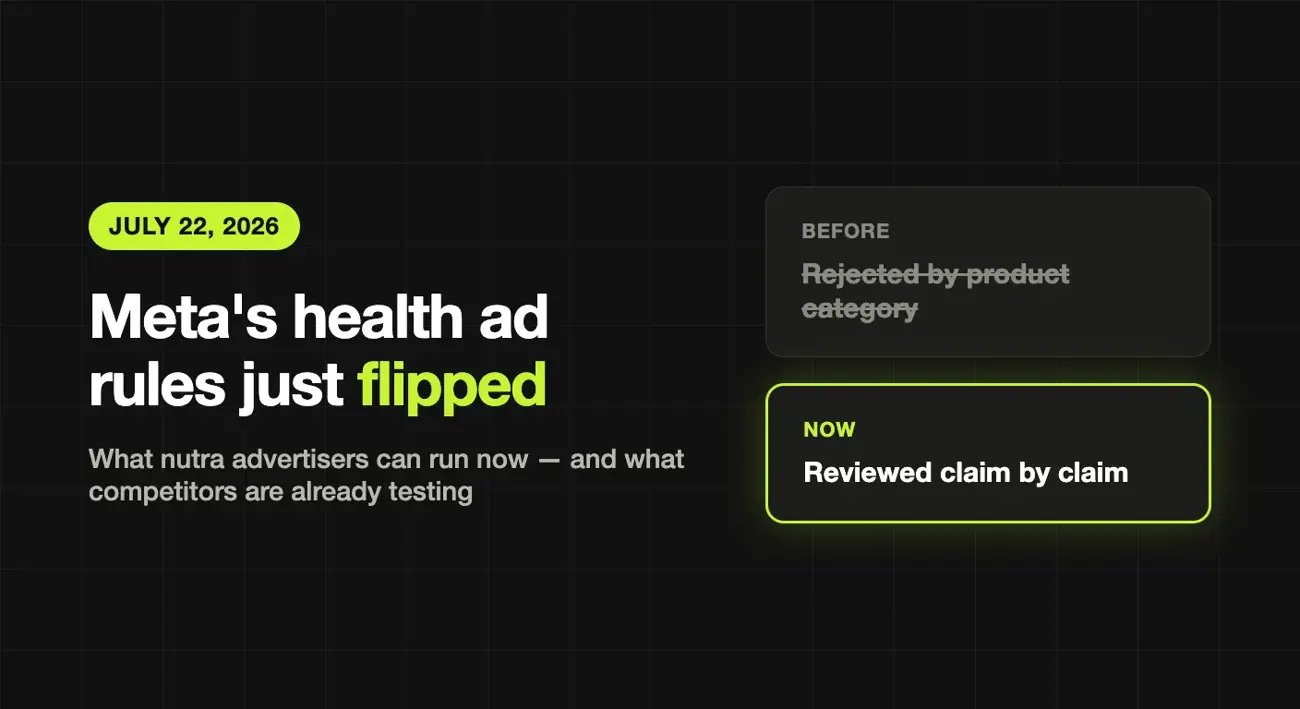
Meta's July 2026 Health & Wellness Policy Update: Before/After Is Back — Here's What Advertisers Are Already Running
On July 22, 2026, Meta rewrote its Health and Wellness Advertising Standards — the biggest change to health ad enforcement in years. The short version: rejection by product category is out, and claim-by-claim review is in. Before/after imagery is no longer auto-rejected. Most supplements no longer require 18+ targeting by default.
Every compliance blog has already summarized the rules. This article does what they didn't: it looks at what health advertisers actually launched in the three weeks since — real ads, real counts, pulled by publish date on August 14, 2026 — and gives you the workflow to audit your own niche before the newly legal territory gets crowded.
Because that's the real story of this Meta health and wellness policy update: it's not a compliance memo, it's a starting gun.
What changed on July 22, 2026: from product-based to claims-based enforcement
Under the old regime, enforcement was triggered by what your ad was: a weight loss product, a side-by-side photo, a supplement bottle. Whole categories of creative were dead on arrival regardless of what the copy said — and health advertisers learned to pre-censor accordingly.
The new regime reviews what your ad claims. The same product, the same image, can pass or fail depending on the sentence next to it:
| Before July 22 | Since July 22 | |
|---|---|---|
| Trigger | Product category and imagery type | The specific claims in your copy |
| Before/after images | Auto-rejected for weight loss and cosmetics | Allowed unless paired with a prohibited claim |
| Supplements | 18+ targeting required by default | No default age restriction (with one big exception — below) |
| Commerce placements | Restricted for many supplement products | Catalog and shop placements permitted |
| Rejection scope | Whole categories pre-blocked | Individual claims struck |
The wording that matters is in Meta's Advertising Standards — read the health and wellness section yourself before relaunching anything; industry summaries (including this one) are interpretation, not the rulebook.
The new green zone: before/after imagery, supplement targeting, commerce placements
Three doors that were welded shut are now open:
- Before/after and side-by-side imagery for weight loss and cosmetic products is judged by its claims. A transformation photo with compliant copy ("I built this routine over a year") can run; the same photo with "lose 10kg in 3 weeks, guaranteed" cannot. The image stopped being the crime — the promise is.
- Supplements without 18+ targeting. Vitamins, minerals, proteins and general wellness supplements now reach all-age audiences by default. The exception that will catch people: any weight loss or weight gain claim puts the 18+ requirement right back. One sentence in your primary text changes your addressable audience.
- Commerce placements. Supplement products can now sit in catalog and shop placements — which quietly matters more than the headline changes, because it opens Advantage+ catalog campaigns to a vertical that was locked out of them.
What's still banned — and now enforced at the claim level
The update is not an amnesty. Still prohibited:
- Sensational, misleading or guaranteed health claims — cure promises, specific outcome timelines, "clinically proven" without substantiation.
- Pinched-fat imagery and anything designed to make the viewer feel bad about their body. Negative self-perception framing remains the fastest way to a rejection.
- Skin whitening/bleaching and sexual enhancement products — still banned at the product level; claims-based review doesn't apply to them.
And claims-based enforcement cuts both ways: we found a telehealth weight loss ad launched on August 11 — three weeks after the update — already sitting in blocked status. Its copy promised "compounded GLP-1 meds for easy weight loss." The category was fine now; the phrase "easy weight loss" wasn't. That's the new game in one example: your product no longer gets you rejected, your sentences do.
What the first two weeks of post-update ads show (real ad data)
We queried the Adligator database for US ads created after July 22, 2026 that are still active, keyword by keyword (measured August 14; each number covers that keyword only, not the whole vertical):
| Keyword | Active US ads launched since July 22 |
|---|---|
| menopause | 134 |
| GLP-1 | 77 |
| collagen | 76 |
| weight loss | 49 |
| joint pain | 15 |
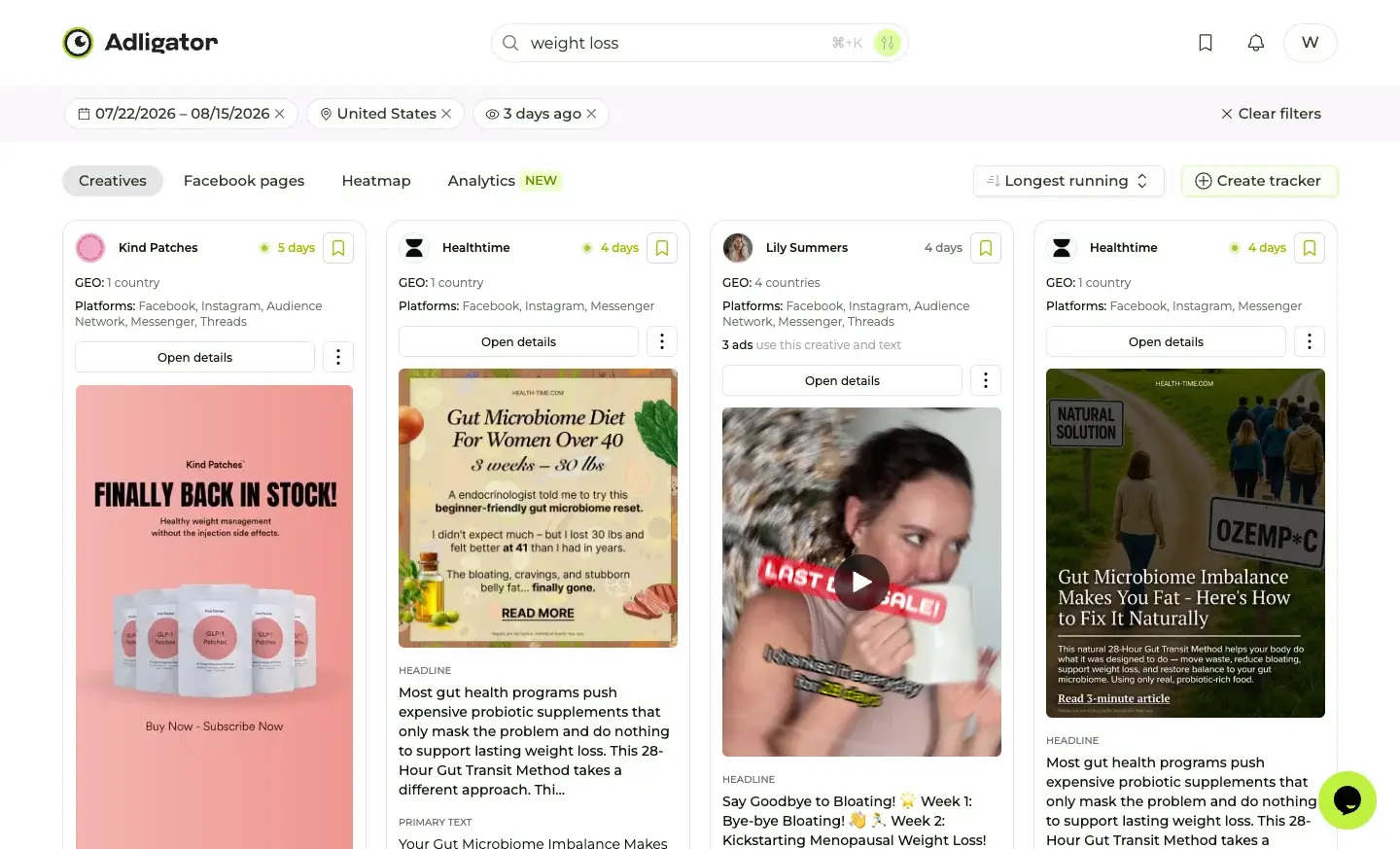 The "weight loss" query, filtered to post-July-22 launches and sorted by runtime — the longest survivors of the new era are 4-5 days old
Three patterns stand out in the results:
- The GLP-1-adjacent supplement wave is the fastest mover. Patch and supplement brands are positioning directly against injections — "healthy weight management without the injection side effects" — with SHOP_NOW commerce funnels that would have been an 18+ advertorial play six months ago. One patch brand launched near-identical creatives across multiple landing pages within days of each other: classic post-policy A/B probing.
- Advertorial statics are testing the new image latitude immediately. Gut-health advertorials in the sample pair food-photography statics with aggressive numeric claims ("3 weeks — 30 lbs"). Expect a chunk of these to get struck at the claim level like the blocked telehealth ad — watching which survive their first month is exactly the point of tracking this cohort.
- Women's-health positioning (menopause) is the biggest single cluster — 134 fresh ads, mostly supplement brands wrapping weight and hormone messaging inside menopause support framing, now with all-age commerce placement available.
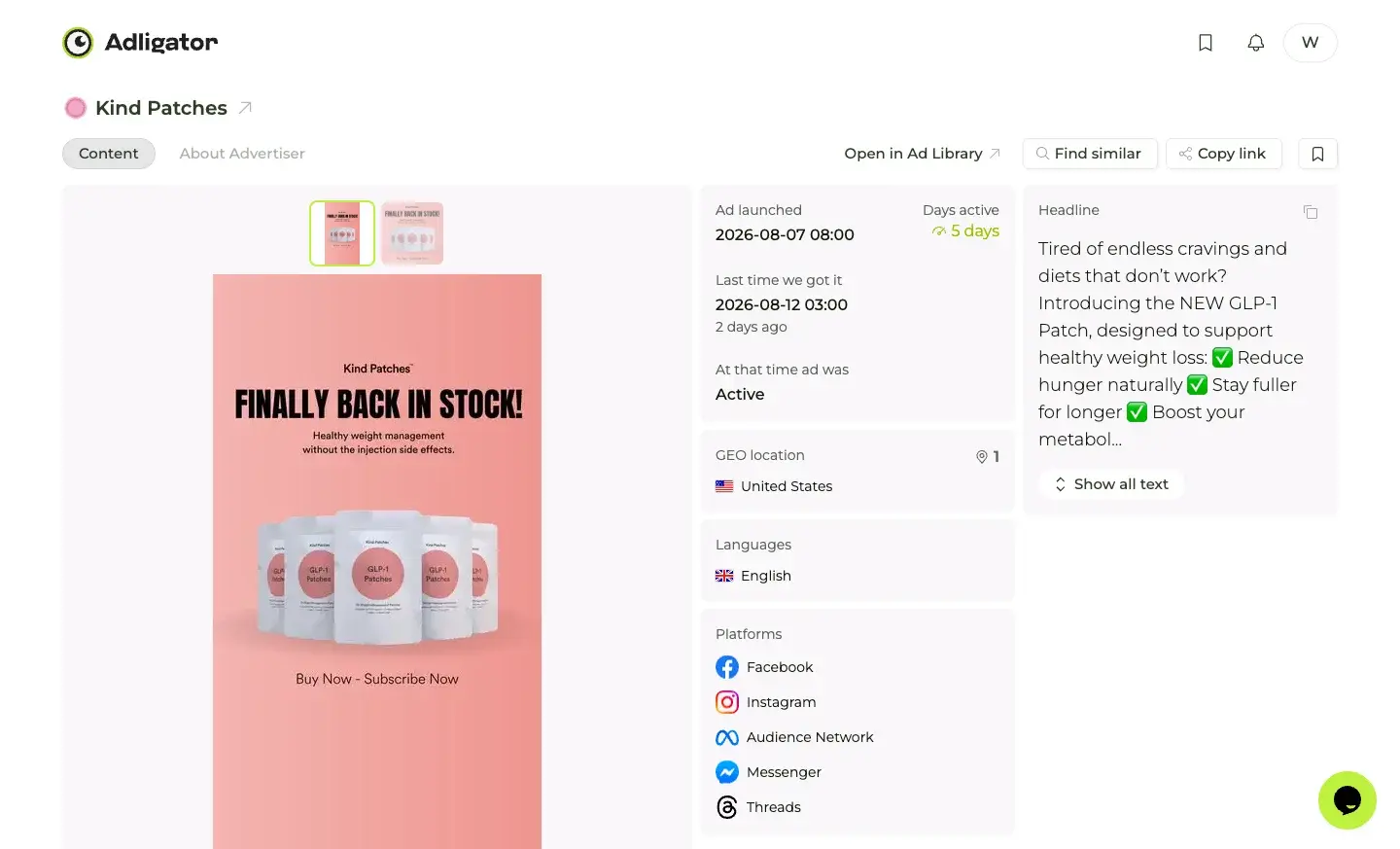 The detail view answers the audit questions per ad: launched August 7, still active, SHOP NOW straight to a product page
Want the same view for your niche? See what health advertisers launched after the policy change — search by publish date free
How to audit competitor health ads for newly-allowed patterns: the workflow
The question that matters after any policy change: what are the winners doing with it? Meta's Ad Library can show you one advertiser at a time, but it has no publish-date filter across advertisers and no runtime sort — "show me all health ads launched since July 22, sorted by how long they've survived" is simply not a query it can run.
Here's the workflow that produced this article's data, reproducible for any niche in about 20 minutes:
- Map your niche into 3-5 buyer keywords. Not "nutra" — the words that appear in ad copy: your ingredient (collagen, berberine), your problem (joint pain, menopause), your mechanism (GLP-1). Category words return a thin, misleading slice.
- Query each keyword with three filters: GEO (US), creation date from July 22, 2026, and last-seen-active within days. Record the count per keyword — that's your baseline for how fast the niche is moving post-update.
- Sort by "Longest running." Three weeks in, runtime is the only performance proxy available for this cohort. Anything from the post-update batch that's still alive at 14+ days survived both the algorithm and the new claim review.
- Open the survivors and read them like a reviewer. Which imagery pattern? What exact claim phrasing sits next to a before/after? Does the supplement copy avoid weight claims (all-age) or embrace them (18+)? This is the claim-level vocabulary you'll rebuild your own creatives with.
- Put trackers on the 2-3 pages testing hardest. A tracker collects a page's new launches daily and unlocks the Analytics tab — launch cadence, CTA mix, image/video split, top hooks. We put one on the supplement brand dominating our collagen and menopause queries: 1,800 ads launched in 30 days, 100% web funnel, Shop now on 95.6% of them, 59/41 image-to-video split. That's what "testing into the new policy" looks like from above — track your top 3 nutra competitors and get their new creatives automatically.
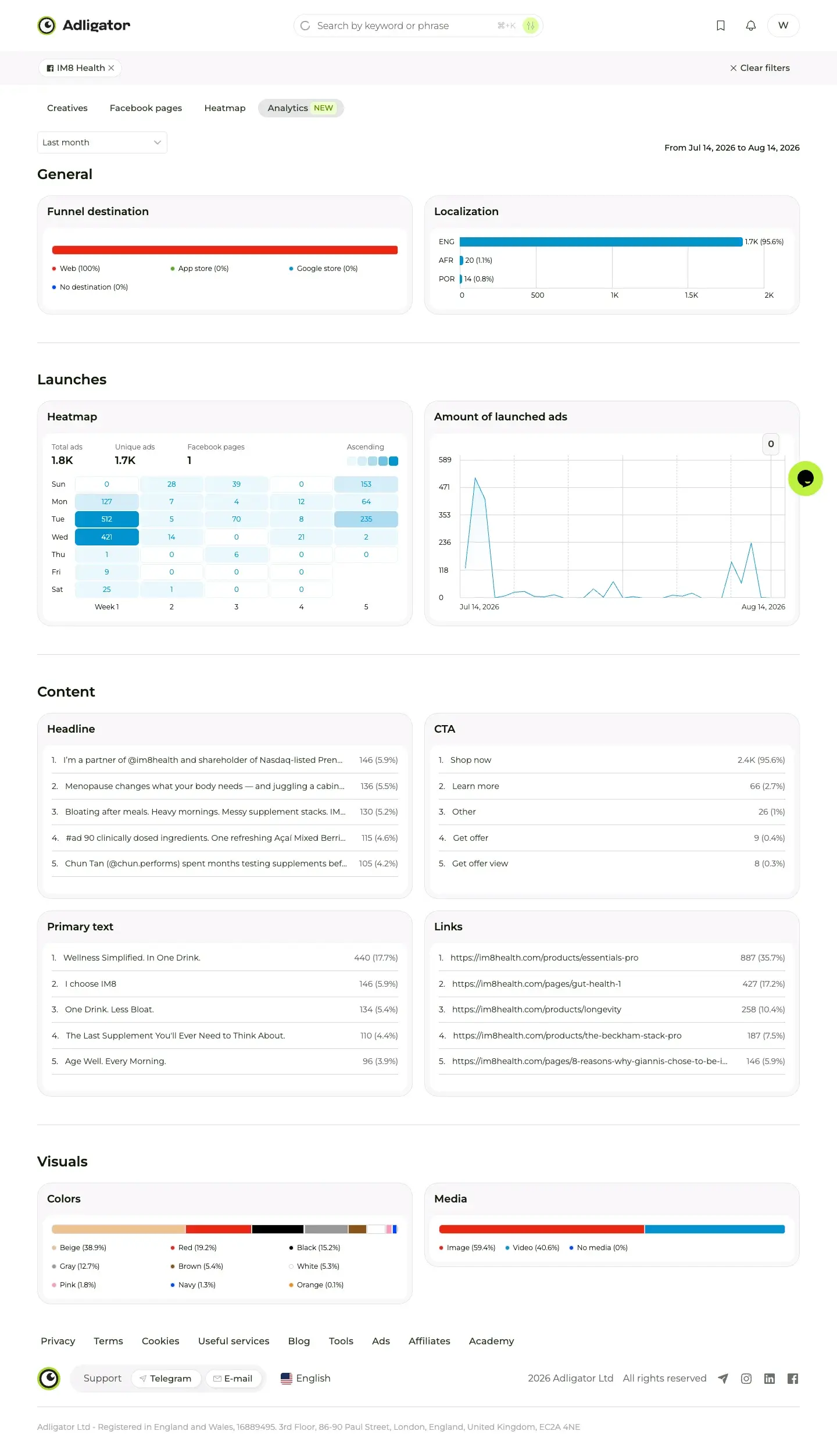 Tracker analytics on one supplement brand, last 30 days: 1.8K launches, all web-funnel, Shop now near-universal
For the deeper version of this workflow, see our nutra vertical spy-tool walkthrough and the health & fitness advertising guide.
Rebuilding rejected creatives: a claim-level compliance checklist
If you have a graveyard of previously-rejected health creatives, they're worth re-auditing — some died for reasons that no longer exist. Run each one through this list:
- Why did it die? If the rejection was category-triggered (before/after image, supplement + broad audience), the creative may now be viable as-is. If it was claim-triggered, it's still dead.
- Strip outcome guarantees. Numbers + timeframes ("30 lbs in 3 weeks") are claim-level violations regardless of imagery. Replace with process framing and individual-experience framing.
- Check the weight-claim switch. Supplement ad with no weight claims → all-age delivery. Add "supports weight loss" → 18+ required. Decide which side of that line each creative lives on deliberately, not accidentally.
- Audit the image in isolation, then the pair. A compliant image next to a violating sentence fails. Reviewers now read the combination.
- Relaunch in small batches and track survival. Claims-based review means more nuance and more variance. Runtime is your feedback loop — creatives that clear 14 days are your new compliant library. Our compliance audit workflow covers how to systematize this.
- Watch your CPMs by market while you scale. If the relaunch works, your next constraint is cost — see our country-level CPM impact data.
FAQ
Can I use before/after photos in Facebook ads in 2026?
Since July 22, 2026, before/after and side-by-side imagery is no longer auto-rejected for weight loss and cosmetic products. It's allowed as long as the paired claims are compliant — no guaranteed outcomes, no timelines, no statements that make the viewer feel inadequate. The image is now judged by the claim next to it.
Why does my supplement ad still need 18+ targeting?
Vitamins, supplements and protein products can now run without 18+ targeting by default — but the exception is weight loss or weight gain claims. The moment your copy claims the product aids dietary weight change, the 18+ requirement comes back. Same product, different claim, different rule.
What health claims still get ads rejected?
Sensational or misleading health claims, guaranteed outcomes, pinched-fat imagery, and anything implying personal negative attributes remain violations. Skin whitening and sexual enhancement products stay banned at the product level. Claims-based review means one bad sentence can sink an otherwise compliant ad.
How do I see competitors' new health ads?
Meta's Ad Library shows any advertiser's active ads page by page, but it can't filter by launch date across advertisers or sort by runtime. An ad intelligence tool like Adligator lets you query a keyword plus a publish-date window plus a longevity sort in one search — that's how the post-July-22 data in this article was pulled.
Conclusion
The July 2026 Meta health and wellness policy update moved the fence: creative formats that were category-banned for years — before/after imagery, all-age supplement delivery, commerce placements — are now open ground, policed sentence by sentence instead of product by product. The advertisers treating this as a compliance memo will re-read the rules; the ones treating it as a starting gun are already three weeks and several hundred test launches ahead — 351 fresh active US ads across just the five keywords we measured.
The winners of the next quarter in health advertising will be decided by who audits fastest: who sees which newly-legal patterns survive claim review, and who rebuilds their creative library around them first.
Ready to run the audit? See what health advertisers launched after the policy change — search by publish date free
Sources consulted: Meta Advertising Standards (transparency.meta.com) · Meta Health & Wellness Ad Policy Update (clikim.com) · Meta Ad Policy Updates 2026 Guide (auditsocials.com) · Meta Health and Wellness Ads Policy Update (run1ads.ai)
Related Reading
- Facebook Ad Compliance Guide for Media Buyers: How to Avoid Account Bans While Running Aggressive Creatives in 2026
- What 120+ Active Dating Ads Targeting South Africa Reveal About Running Meta's Toughest Vertical
- Facebook Ads for Health and Fitness: How to Promote Gyms, Supplements, and Wellness Brands (2026)
- How to Detect Ad Creative Fatigue Before It Kills Your ROAS: A Media Buyer's Checklist
