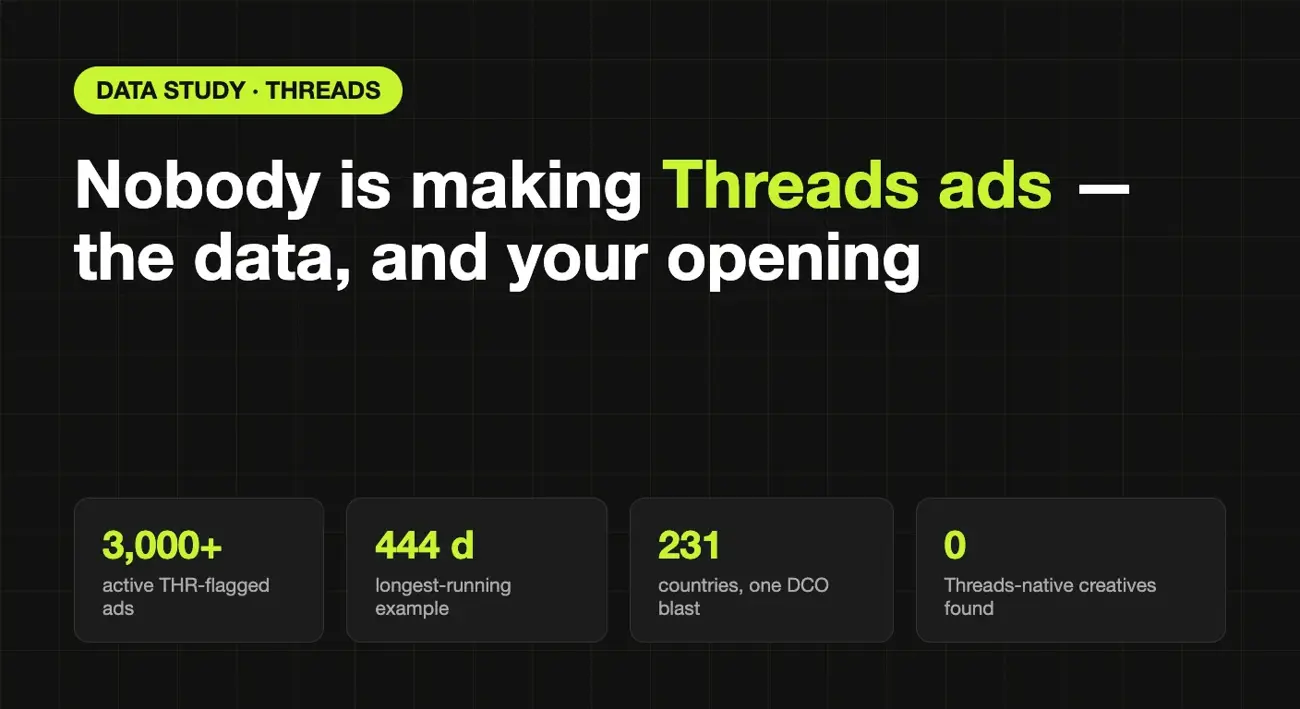
Nobody Is Making Threads Ads: The Data — and Why That's Your Opening
Threads ads went global on January 21, 2026. Seven months later, the question media buyers keep asking — should I advertise on Threads? — has produced hundreds of how-to-enable guides and exactly zero published data on who actually advertises there and with what.
So we pulled the data. Using Adligator's placement filter, we ran a census of every active ad in the library flagged for Threads delivery: more than 3,000 ads, from day-old tests to a 444-day veteran.
The headline finding is the contrarian one: nobody is really making Threads ads. The longest-running "Threads ads" are 200-country Advantage+ blasts that happen to include Threads. In our samples we found no creative built for the platform. Threads placement in mid-2026 is spillover inventory — and if you're a creative strategist, that's not a disappointment. That's an opening.
Threads ads, 7 months after global rollout: the state of play
The coverage cycle around Threads advertising has three genres: rollout news (January), "how to enable or opt out" help content, and think-pieces about whether a text-first feed can monetize. None answers the practitioner's questions: who is actually in this inventory, what creative do they run, and has anyone committed real budget to it?
Those questions are answerable — just not with Meta's own tools. The Ad Library shows platform icons on each individual ad but offers no placement filter, so a placement-level census means opening ads one at a time across thousands of pages. Adligator stores the placement list per ad and filters on it, which turns "impossible afternoon" into one query.
Methodology: how we pulled Threads-placement ads
The census, run August 14, 2026:
- Platform filter: Threads — every ad whose Meta placement list includes Threads.
- Active recently — last seen delivering within days of the pull.
- Sort: longest running for the veterans; default sort for the freshest cohort.
 The census query: Platform = Threads, sorted by longest running — a view the native Ad Library cannot produce
Scale check: the result set maxes out our pagination at 150 pages — and a probe of the very last page at 20 results per page still returns a full page. That puts the floor at 3,000+ active Threads-flagged ads, well beyond what we can hand-review, so the findings below combine full-list sorting (for the veterans) with two 20-ad samples (the longest-running cohort and a deep page of the freshest cohort).
One honest limitation before the findings, because it frames everything: a placement flag records where an ad can serve, not where impressions actually went. An ad flagged for five placements may get 2% of its delivery from Threads or 20% — that split lives only in the advertiser's own Ads Manager. This census maps supply and intent, not impression share.
Finding 1: the longest-running Threads ads are 200-country Advantage+ blasts
The top of the longest-running list, as of August 14:
| Advertiser | What it sells | Days active | Countries |
|---|---|---|---|
| Bavariasis Tracht | Oktoberfest dirndls (German copy) | 444 | 3 |
| Goda Perfume | Pheromone perfume | 442 | 29 |
| Warodom Hair Clinic | Hair transplants | 440 | 1 |
| Flower Knows Cosmetics | Cosmetics (DCO catalog) | 397 | 231 |
| Lost Dutchman Leather | Leather wallets | 393 | 233 |
Two of the top five target more than 230 countries with a single catalog-driven DCO ad. Further down the list sit an IronPanda gym-apparel ad on 169 countries, crypto platform Nexo on 13, and Nike running Thai DPA ads for 353 days. These are not Threads strategies — they're Advantage+ placement defaults doing what defaults do: serving everywhere Meta allows, Threads included.
The clincher is the placement list itself. We opened the detail pages on both the oldest veteran and a day-old test, and both carry the identical five-placement stack: Facebook, Instagram, Audience Network, Messenger, Threads.
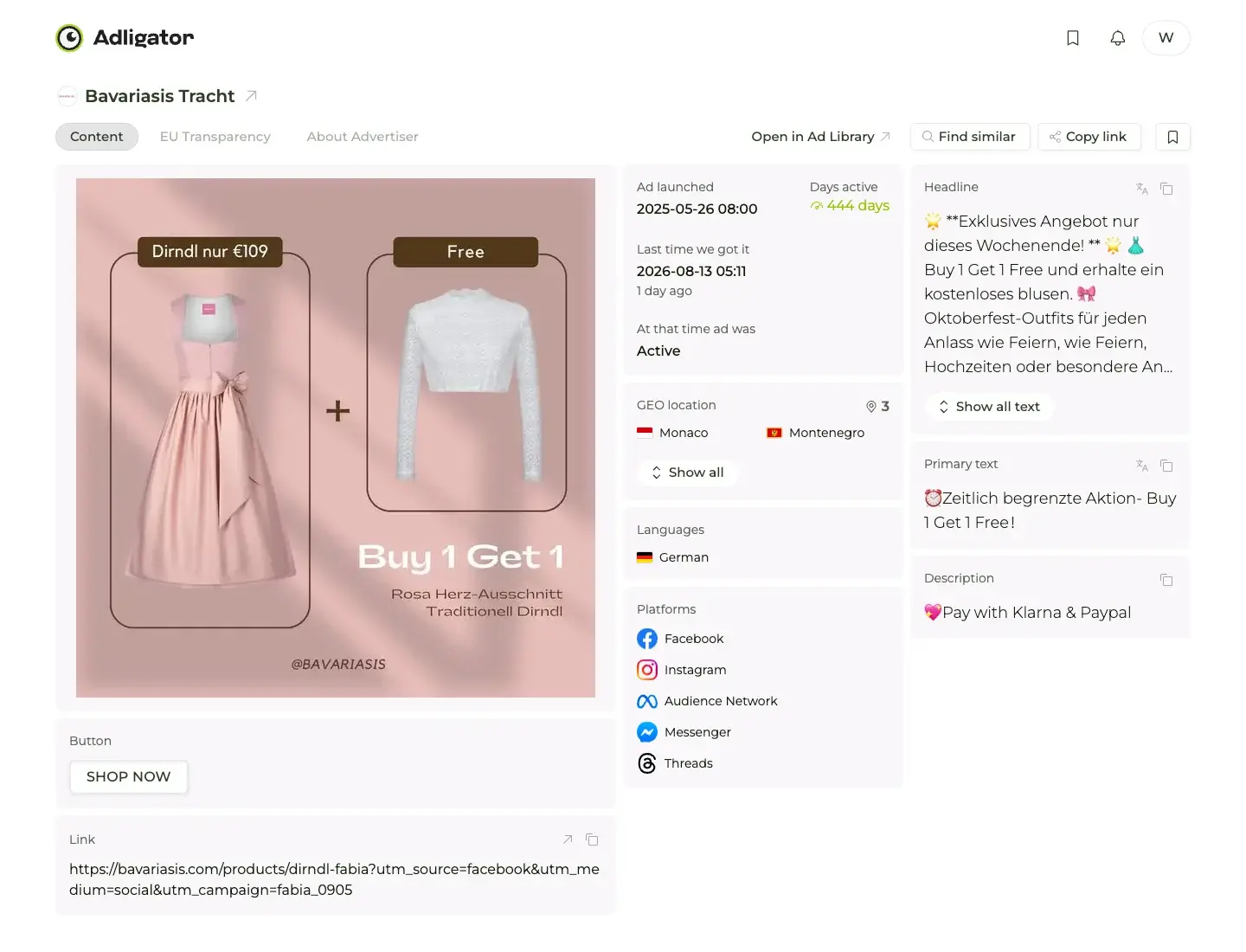 The longest-running Threads-flagged ad in our pull: 444 days — with Threads listed fifth among five placements
Finding 2: recycled Facebook creative, zero Threads-native formats
Threads is a text-first feed. If advertisers were designing for it, you'd expect what early Twitter/X advertisers produced: copy-led creative, conversational hooks, screenshots of posts.
We found none of that. Across both samples — 40 ads spanning the extremes of the longevity curve — every creative is standard Facebook/Instagram fare: product video, catalog DCO cards, before/after statics, the usual hook patterns. The 444-day dirndl ad is a product photo with emoji-heavy German e-commerce copy ("Buy 1 Get 1 Free"). The freshest cohort is dominated by short-drama streaming apps (ReelShort, DramaBox, DramaWave and their clone pages) pushing vertical video episodes with WATCH_MORE buttons — creative built for Reels, served wherever Meta will place it.
In seven months of global availability, we could not find a single ad in our samples that a viewer would identify as made for Threads. That's the "nobody is trying" claim, stated precisely: not zero delivery, but zero observable creative investment.
Finding 3: who actually shows up on Threads placement (verticals & advertisers)
The advertiser mix says "everyone and no one":
- DTC e-commerce everywhere — dirndls, perfume, leather goods, mascara, gym shirts. Mostly mid-size stores riding Advantage+ defaults.
- Short-drama and novel apps own the fresh cohort. The deepest pages of the newest ads are wall-to-wall episodic video apps, testing per-GEO cells (single tiny markets like Aruba, Bonaire or the Falklands per ad set) at industrial scale.
- Wellness and gray-adjacent offers persist — detox teas, prostate remedies, sleep-music subscriptions with LISTEN_NOW buttons running 368–380 days.
- A few giants by accident: Nike's Thai catalog ads have carried the Threads flag for nearly a year — almost certainly a placement default nobody at Nike has thought about.
What's absent is the point: no advertiser whose presence suggests a deliberate Threads play. No text-first brand voice, no Threads-specific offers, no creative testing visible around the placement.
Run this census on your own vertical: see who advertises on Threads right now — filter by placement in Adligator, free
The contrarian take: spillover inventory is cheap attention
Everyone asks whether Threads ads "work." The data reframes the question: Threads is currently an auction where nearly all supply comes from advertisers who don't know they're in it. Nobody is bidding for Threads; they're bidding for Meta's blended auction, and Threads impressions come along.
Historically, that's what underpriced attention looks like. When competition on a surface is unintentional, the advertiser who shows up on purpose — creative that reads native, offers that fit the context — competes against defaults, not against rivals. A Kyiv-based DTC brand, say, could test Threads-flagged campaigns with conversational, text-led hooks for its Ukrainian audience and be functionally the only advertiser in the country designing for the surface.
The honest counterweight: spillover status also means Meta hasn't proven the surface converts, and impression share per placement is invisible from the outside. This is an argument for a measured test, not a budget shift — run it, break out Threads in Ads Manager's placement report, and let your own numbers decide.
How to monitor who tests Threads before your competitors do
The strategic question isn't today's census — it's when does that change. The moment a competitor starts designing for Threads, you want to know that week, not in a quarterly think-piece.
Manually, that means re-opening competitor ads in the Ad Library and squinting at platform icons — the exact workflow that doesn't scale past one brand. The automated version takes two minutes:
- In Adligator, search your competitor's Facebook page (or your vertical keyword) with the Platform: Threads filter.
- Save the search as a tracker — Adligator then collects new matching creatives daily.
- Open the tracker's Analytics tab for the aggregate view: launch cadence, language mix, funnel destinations across everything collected.
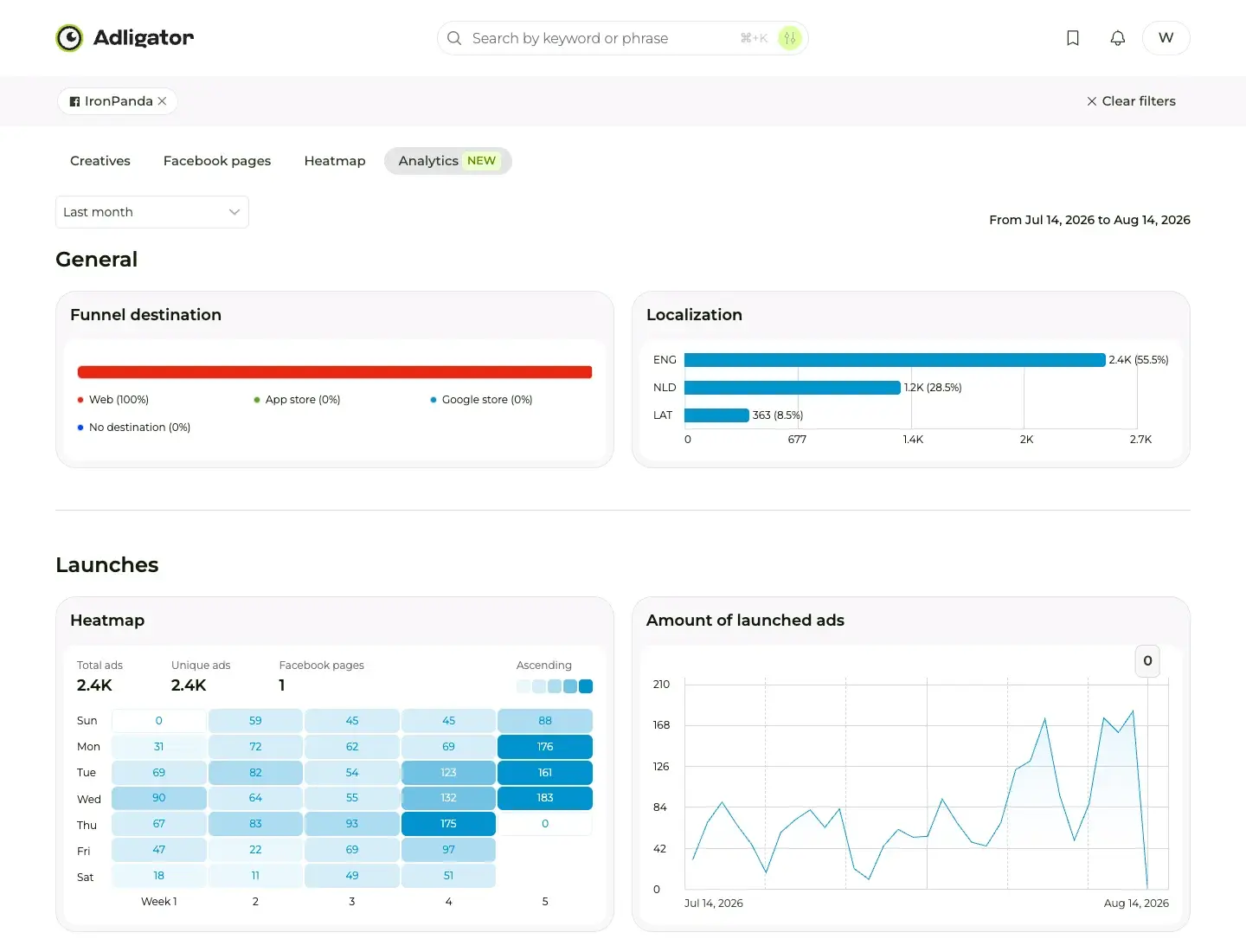 A tracker's Analytics tab: the competitor's whole month of launches, languages and funnels on one screen
This tracker follows IronPanda — the gym-apparel brand from our longevity top-20. One screen shows its month: every launch, 100% web funnel, a language mix leaning English and Dutch. When any tracked competitor's creative mix shifts toward a new placement or format, it surfaces here first — that's your early-warning system for creative trends generally, Threads included.
Set it once: track a competitor and get notified when they start testing Threads
Should you opt out of Threads placement? A decision framework
Three positions, in rising order of effort:
- Leave it on (default). Right for most performance accounts. Spillover delivery is small, Meta's blended optimization usually beats manual pruning, and opting out costs optimization freedom. Just break out Threads in your placement reports so the decision stays data-backed.
- Opt out — manual placements, Threads unticked. Justifiable mainly for strict brand-safety or compliance policies that require reviewing every surface, or when your placement report shows Threads spending without returning. Accept the trade-off: manual placements disable cross-surface optimization.
- Lean in deliberately. For brands whose voice fits a text-first feed, run the cheap experiment nobody else is running: Threads-included campaigns with conversational, copy-led creative, measured against your standard mix. If the surface converts for you, you're early; if not, you've spent a test budget learning it before your competitors spent theirs.
The one indefensible position is the most common one: having an opinion about Threads ads without ever having looked at the placement data — yours or the market's.
FAQ
Can you run ads only on Threads?
Yes — Meta lets you manually customize placements and select Threads alone, the same way you'd isolate Instagram. In practice almost nobody does: every long-running Threads-flagged ad we opened also runs on Facebook, Instagram, Audience Network and Messenger, because advertisers leave Advantage+ placements on.
How do I see which competitors advertise on Threads?
Meta's Ad Library has no placement filter — you'd have to open ads one by one and read the platform icons. In Adligator, set the Platform filter to Threads (optionally combined with a keyword or a competitor's Facebook page) and every ad flagged for Threads placement comes back as a filterable, sortable list.
Do Threads ads have separate CPMs?
Meta reports performance per placement in Ads Manager, so you can break out Threads delivery and cost after the fact. Public benchmark data for Threads CPMs is still thin; treat any specific number you read as anecdotal until Meta or large-scale advertiser studies publish placement-level benchmarks.
How do I opt out of Threads placement?
In Ads Manager, switch the ad set from Advantage+ placements to manual placements and untick Threads. Remember the trade-off: manual placements disable Meta's cross-surface optimization, which usually costs more than the spillover you're trying to avoid.
Conclusion
Seven months in, the threads ads story isn't the one anyone predicted: 3,000+ active ads carry the placement, the veterans among them have run for over 400 days — and none of it is intentional. Threads inventory today is Advantage+ spillover wearing a new logo.
For most accounts, that means leave the default on and watch the placement report. For creative-led brands, it means the rarest thing in Meta advertising: a surface where showing up on purpose makes you the only one. Either way, the advantage goes to whoever sees the shift first.
Watch the shift happen: see who advertises on Threads right now — filter by placement in Adligator, free
Sources consulted: "Threads rolls out ads to all users worldwide" — techcrunch.com · Meta Ads Manager placement documentation — facebook.com
Related Reading
- What 120+ Active Dating Ads Targeting South Africa Reveal About Running Meta's Toughest Vertical
- Facebook Ad Compliance Guide for Media Buyers: How to Avoid Account Bans While Running Aggressive Creatives in 2026
- Facebook Ad Creative Lifespan: How Long Do Ads Last Before Fatigue? Data-Backed Guide (2026)
- Facebook Ad Creative Trends 2026: What Spy Tools Reveal About Winning Formats, Hooks, and CTAs
