Copying Competitor Facebook Ads Is Quietly Killing Your ROAS — Here's What to Do Instead
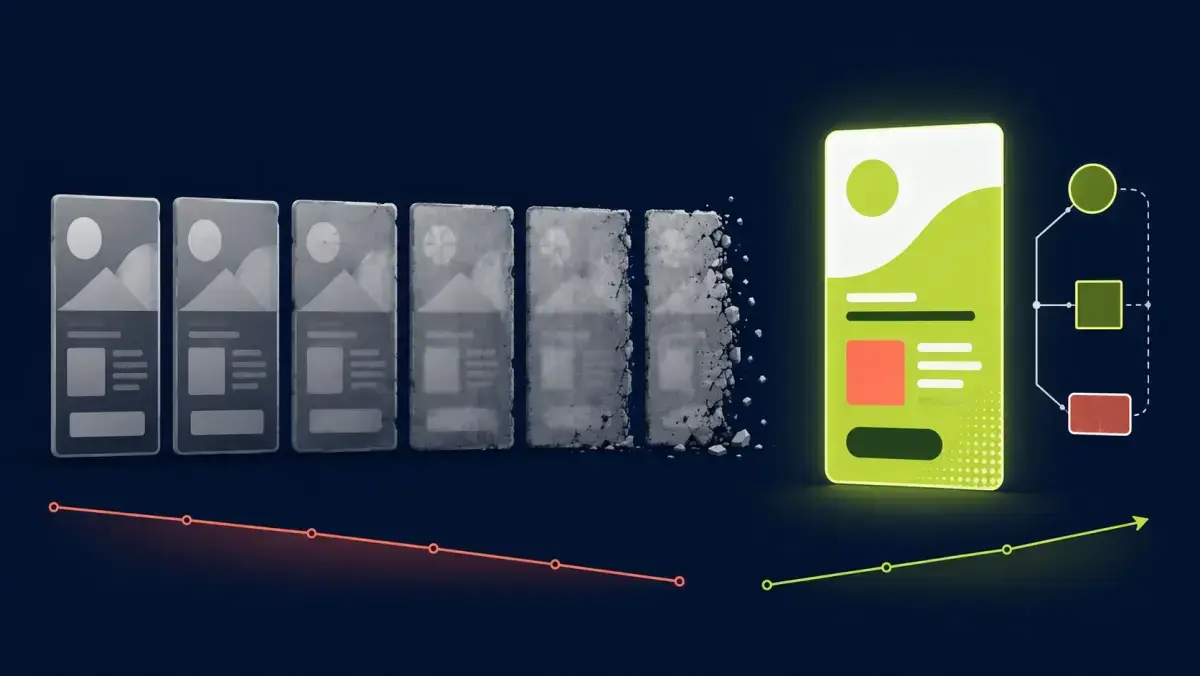
Every media buyer has done it. You find a competitor's ad that has obviously been running forever, you rebuild it almost frame for frame with your own product, you launch it — and it does fine for nine days and then quietly dies.
You didn't do anything wrong by looking. Copying competitor Facebook ads is normal practice, and the swipe folder is a legitimate tool. The problem is what most people take out of the folder: the picture instead of the pattern.
This piece takes a position. Cloning a competitor's creative is a structurally losing move, for reasons that have nothing to do with your design skills. What works instead is modeling — extracting the transferable layers and rebuilding them as something of your own. Below is why the clone fails, the four layers that actually travel between brands, and a workflow you can run this week.
The seductive trap: "just copy the winning ad"
The logic feels airtight. Their ad has been running for months, so it must be profitable. Profitable ads are rare. Therefore: replicate it and inherit the profit.
Three things are wrong with that chain.
You're buying at the top. By the time an ad is old enough for you to notice, it has already spent months harvesting the cheapest, most responsive slice of the audience. You aren't copying the ad they launched — you're copying the ad that's left after the easy conversions are gone.
You don't know why it works. You can see the creative. You cannot see the audience it's served to, the budget behind it, the landing page it points at, the brand equity carrying it, or the retargeting stack behind the click. Copy the visible 20% and you've reproduced the least important part.
You inherit their constraints, not their advantages. Their creative was built around their margin, their guarantee, their delivery times, their proof. Yours has none of that behind it — so the same words carry less weight.
Why clones fatigue faster in a saturated auction
Here is the mechanic most "copy the winners" advice skips.
Meta's auction serves ads to people, and a person who has just seen a competitor's version of a creative and skipped it does not become newly interested when your near-identical version appears an hour later. Two similar ads chasing the same audience produce overlapping delivery, higher effective frequency, and falling incremental response — which shows up in your account as rising CPM and cost per result while your CTR sags.
The more successful a competitor's creative is, the worse this gets, because success is exactly what attracts other copies. By the time five brands in a vertical are running variations on the same visual, the format itself has been trained out of the audience. The pattern still works. That specific execution does not.
Which is the whole argument in one line: the thing that fatigues is the execution, not the strategy behind it.
Copying vs modeling: the difference that decides ROAS
The distinction is simple enough to apply in a meeting.
Copying = reproducing the execution. Same footage type, same layout, same edit rhythm, same lines with the product name swapped. The test: could a viewer put your ad and theirs side by side and call them the same ad?
Modeling = extracting the strategy and rebuilding it. Same underlying angle, same hook structure, same offer mechanic — expressed in your product, your proof, your voice, your format. The test: can you write down what you took in one sentence, without naming their product?
If you had to open their creative to build yours, you copied. If you could have built yours from a one-line note, you modeled.
Copying gives you a creative that starts halfway down someone else's fatigue curve. Modeling gives you a creative that starts a fresh one — and, more importantly, gives you a repeatable input for the next twenty creatives instead of a single asset.
The 4 transferable layers to extract
Not everything in a competitor ad travels. Split it into four layers and you'll know instantly what to take.
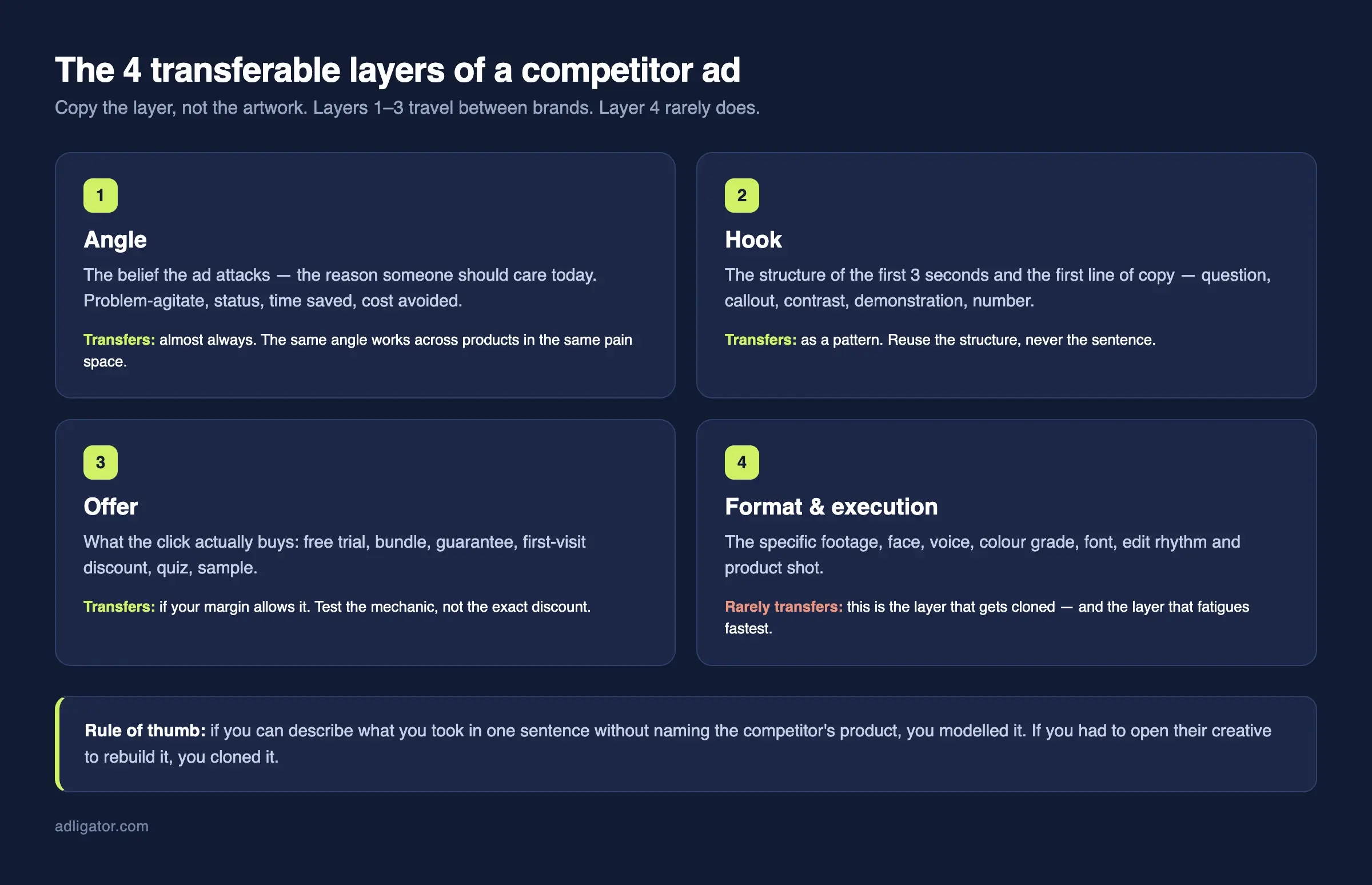 Three layers travel between brands. The fourth is the one everyone copies — and the one that fatigues fastest.
Layer 1 — Angle. The belief the ad attacks. "Laser doesn't work on hormonal hair." "You're paying for storage you don't use." "Your dog's food is the reason for the itching." Angles transfer almost perfectly, because the underlying human problem is not brand-specific. This is the single most valuable thing in any competitor ad and almost nobody writes it down.
Layer 2 — Hook. The structure of the first three seconds and the first line of copy — question, direct callout, before/after contrast, live demonstration, specific number. Hooks transfer as patterns. "Open with a specific, disqualifying callout" is transferable. Their exact sentence is not.
Layer 3 — Offer. What the click actually buys: a free trial, a bundle, a guarantee, a first-order discount, a quiz, a sample. Offer mechanics transfer if your margin allows them. Test the mechanic, not their exact discount — the percentage is a function of their cost base, not yours.
Layer 4 — Format and execution. Footage, face, voice, colour grade, font, edit rhythm, product shot. This is the layer everyone copies and the one that rarely transfers. It's tuned to their brand and it's already burning through its audience.
Take layers 1–3. Rebuild layer 4 from scratch, every time.
Soft CTA: Find the patterns that endure — not the ads that fatigue — with Adligator's creative analytics
How to read competitor data for patterns instead of pictures
A swipe folder full of screenshots can't tell you which of those layers is doing the work, because a screenshot is a single frozen moment. What you need is the two things a screenshot can never show: how long a creative survived, and what recurs across the whole vertical.
Start with survival. Sort a market's ads by how long they've been running and the picture changes immediately.
 Sorted by longest running, the survivors in one vertical have been live for years — these are the patterns worth studying.
In this hair-growth example, the top creatives have been live for 1,641, 1,330, 1,266 and 1,240 days. Nobody funds four years of unprofitable delivery. Whatever those ads are doing at the angle and offer layers is durable — and notice that they look nothing like each other. A practitioner-authority ad, a before/after grid, a plain product photo, an explainer graphic. Four completely different executions, all surviving. That is the proof that the execution isn't the moat.
Then zoom out from individual ads to the vertical's aggregate patterns.
 The Analytics tab ranks what recurs across thousands of ads — patterns, not individual creatives.
This is the view that changes how you brief creative. Across the tracked keyword, Shop now accounts for 59.2% of CTAs and Learn more for 21.3% — a 3:1 split between direct-response and advertorial routing, which tells you what the category's funnel actually looks like before you've spent a cent. The recurring primary texts and destination links show which offers and landing structures the market keeps returning to.
Notice what you're reading here. Not "here's a good ad to copy" but "here's what this market has converged on". Those are patterns, and patterns are safe to model. Individual creatives are not.
The modeling workflow, with a worked example
Five steps. Twenty minutes per competitor once you've done it twice.
- Filter for survivors. Pull the vertical's ads with 30+ days active. Ignore everything launched in the last fortnight — it hasn't been judged yet.
- Write the angle in one sentence. No product names, no brand names. If you can't do it in one sentence, you haven't found the angle.
- Name the hook structure. Not the words — the shape. "Disqualifying callout → mechanism → proof."
- Note the offer mechanic and the destination. Where does the click land: a quiz, a product page, a listicle advertorial, a chat thread?
- Rebuild layer 4 from zero. Your footage, your customer, your proof, your format. If your version could be mistaken for theirs, start again.
Worked example (illustrative). Say the survivor is a long-running ad in a skincare-adjacent category. You extract:
- Angle: the treatments this audience has already paid for failed on their specific problem type.
- Hook: disqualify the reader's previous solution in the first line, then name the mechanism yours uses instead.
- Offer: low-commitment first purchase with a results window attached.
- Destination: an advertorial that explains the mechanism before it sells.
Your brief now reads: "Open by naming the treatment our buyer already tried and why it can't work for their case. Introduce our mechanism in one sentence. Prove it with our own customer footage. Route to an explainer page, not the product page. Offer: first order with a 60-day window."
Nothing in that brief is theirs. Every strategic decision in it came from their data. That's modeling — and it generates ten creatives, not one.
When to walk away from a competitor's ad entirely
Not every winner is worth modeling. Skip it when:
- The angle depends on an asset you don't have. A founder's face, a celebrity, a clinical trial, a patent. You can't rebuild what you can't source.
- The offer needs a margin you don't have. Free shipping plus a 90-day guarantee is a supply-chain decision, not a creative one.
- It's brand advertising in disguise. Big brands run creative that works because everyone already knows them. Copy that as a challenger and you get a beautiful ad nobody acts on.
- It's already everywhere. If four competitors are running variations of it, you're late. Find what the survivors were doing eighteen months ago instead.
- You can't articulate why it works. If your only reason is "it's been running for ages", you've found a correlation, not a lesson. Keep looking.
For the deeper mechanics of dismantling a single creative, see our step-by-step framework for reverse-engineering winning ads. To organise what you find, build a swipe file that stores patterns rather than pictures — and to catch your own creatives sliding down the curve, use the creative fatigue detection checklist.
FAQ
Is it legal to copy competitor Facebook ads?
Directly reproducing someone's photography, video, illustration or ad copy is a copyright issue, and reproducing their trade dress or slogans can be a trademark issue. Studying an ad and building something original from the same strategic angle is not. This is general information, not legal advice — check with a lawyer for your specific case.
Should I copy or model competitor ads?
Model. Copying reproduces the execution — the footage, the layout, the exact lines. Modeling extracts the angle, the hook structure and the offer mechanic, then rebuilds them in your own brand, product and voice. Copying inherits their fatigue curve; modeling starts a fresh one.
Why do copied ads stop working?
Two reasons. The creative you copied was already partway through its own fatigue curve when you found it, so you inherit the tail rather than the peak. And an identical creative competes for the same audience in the same auction, so the overlap accelerates frequency and drives up cost per result.
How do I know which competitor patterns are worth modeling?
Longevity. An ad running for 30, 90 or 300 days has survived an auction that kills unprofitable creatives quickly. Sort a competitor's library by days active and study the survivors — the ones launched last week tell you nothing yet.
Conclusion
Copying competitor Facebook ads doesn't fail because it's lazy. It fails because the layer you can see — the execution — is the only layer that doesn't transfer, and it's the layer already burning down in someone else's account before you ever open your editor.
Model instead. Take the angle, the hook structure and the offer mechanic. Leave the footage, the fonts and the exact sentences where you found them. Judge which patterns are worth taking by how long they've survived, not by how good they look in a screenshot. Do that consistently and your swipe folder stops being a graveyard of one-off clones and starts being a pattern library that feeds every brief you write.
Ready to see which patterns actually endure? Track a competitor's creatives and read the patterns in Adligator — start free.
See which competitor creative patterns survive the auction — try Adligator free.
Sources consulted: Adligator ad library and Analytics, data captured 2 August 2026; Meta Ads delivery and auction documentation.
Related Reading
- Winning Facebook Ad Examples Breakdown: 10 Real Ads Analyzed — Why They Work and What to Steal (2026)
- Competitor Landing Page & Funnel Analysis: How to Decode Facebook Ad Funnels
- How to Estimate Competitor Facebook Ad Spend Using Spy Tools and Ad Library Data
- How to Build a Facebook Ad Swipe File That Actually Improves Your ROAS
- Inside monday.com's Facebook Ads Machine: What 1,880 Ads Reveal About B2B SaaS Creative Strategy
