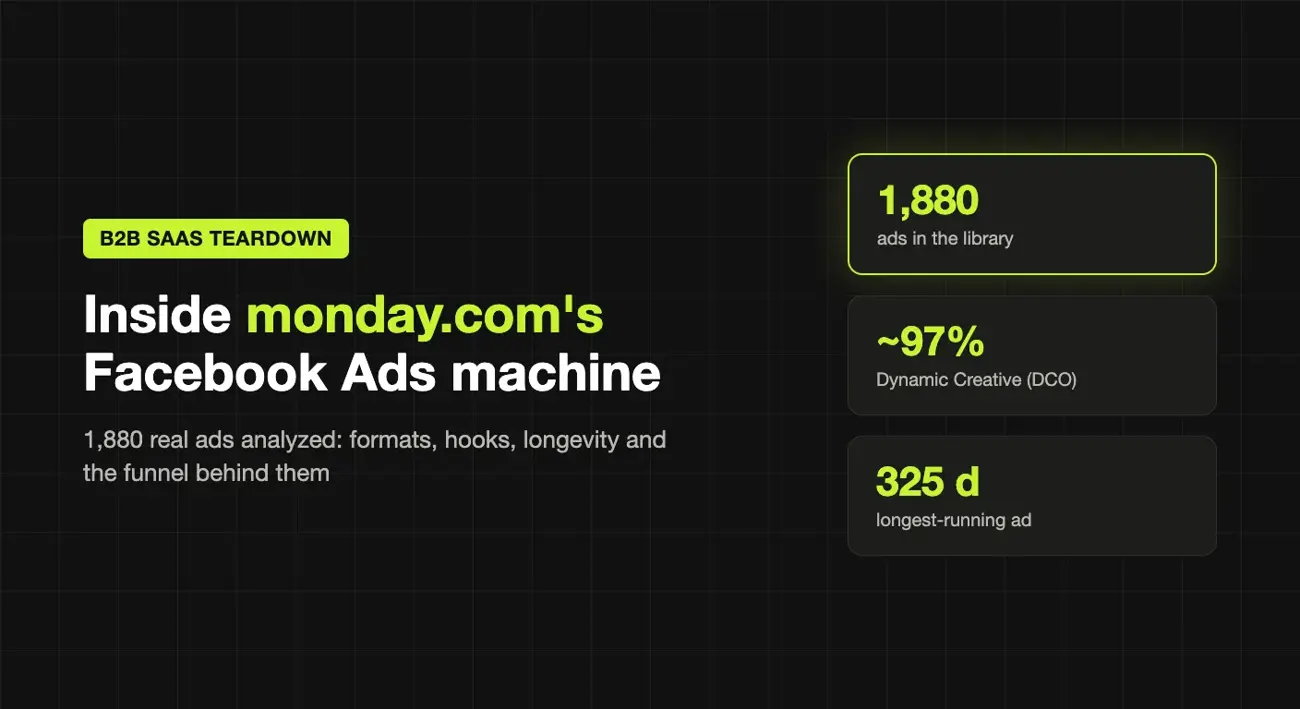
Inside monday.com's Facebook Ads Machine: What 1,880 Ads Reveal About B2B SaaS Creative Strategy
Most B2B SaaS Facebook ads case studies are written by agencies about their own clients — unverifiable wins, cherry-picked screenshots, and a pitch at the end. This one is different: it's an independent, outside-in b2b saas facebook ads case study built by pulling monday.com's actual ad library — 1,880 collected ads — and counting what's really there.
No press kit, no interviews. Just formats, hooks, runtimes, landing pages, and the patterns a smaller SaaS team can copy this quarter. All numbers were pulled on 19 August 2026 by searching monday.com's Facebook page ID (314197722000030); the live Meta Ad Library was cross-checked the same day.
Why monday.com is the B2B SaaS advertiser to study
Three reasons monday.com is the right teardown target and not, say, a hot startup:
- Scale with receipts. Meta Ad Library showed roughly 1,300 active ads for the page on the day we checked. Adligator's collected library for the same page counts 1,880 ads across formats, languages and years — enough volume to read strategy, not luck.
- They've always outspent their category. monday.com's IPO filing famously disclosed about $191 million in sales-and-marketing spend in 2020 — more than that year's revenue. A company that aggressive about paid acquisition, still scaling ads six years later, has necessarily learned what works.
- Meta is a deliberate channel for them, not a leftover. B2B SaaS marketers keep asking whether Facebook works for B2B. A work-OS giant running four figures of concurrent ads is an existence proof worth dissecting.
One rule for this teardown: we only claim what the library shows. No spend estimates (that's a separate method — see our guide to estimating a competitor's Facebook ad spend), no invented ROI.
The shape of a 1,880-ad library: formats, placements, languages
Adligator's page profile counts 1,880 collected ads for monday.com; about 1,550 of them are individually searchable with filters. Slicing that set by display format produces the single most important finding of this case study:
- DCO (Dynamic Creative Optimization): ~1,520 ads — roughly 97% of everything.
- Plain video: 23 ads.
- Carousel: 16 ads.
- Static image: 2 ads.
monday.com barely ships "an ad" in the classic sense. They ship component sets — batches of headlines, screen recordings and static frames — and let Meta assemble the combinations. The creative team's job is industrialized: produce variant components, not finished one-off ads.
Placements follow the money: the performance ads run across Facebook, Instagram, Audience Network and Messenger simultaneously. Languages span English, German, French and more — and the regional structure is visible in the GEO targeting: dedicated DACH campaigns (Germany, Austria, Switzerland), French-Belgian clusters, and one English ad we found running in 29 countries at once.
The CTA distribution completes the picture: approximately 1,400 of ~1,550 searchable ads — about 90% — carry a SIGN UP button. Not Learn More. Not Contact Us. monday.com's Meta machine is a self-serve trial machine.
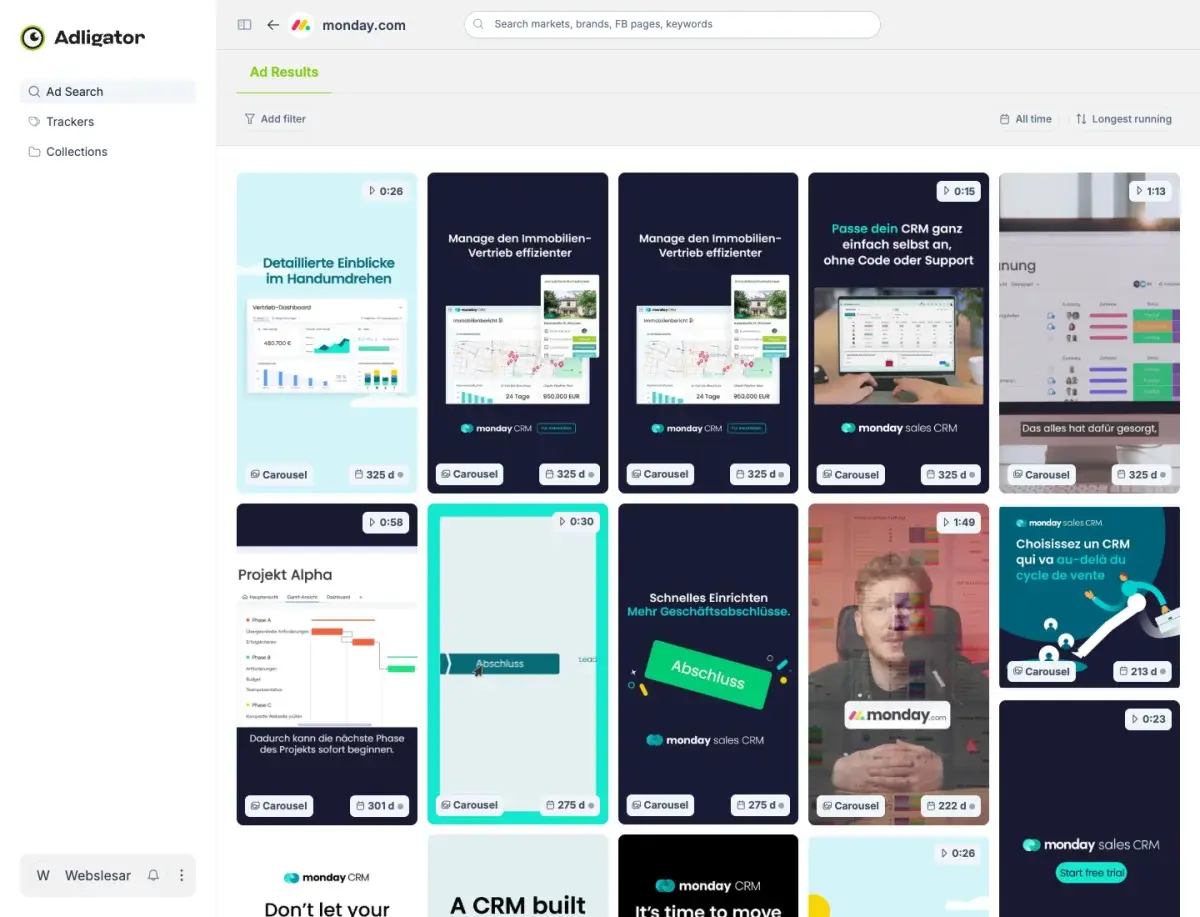 monday.com's library sorted by longest running: the top of the list is wall-to-wall German-language CRM creatives at 325 days (searched by page ID, 19 Aug 2026).
Method note: everything above came from one page-ID search with format filters — the same search you can run free in Adligator on any advertiser.
The hooks: how a work OS sells itself in 3 seconds
Read a few hundred cards and the hook system falls into four repeatable buckets:
1. Benefit + free trial, no cleverness. The longest-running ad in the entire library opens (translated from German): "monday sales CRM simplifies and automates routine tasks so you have more time to close deals. Try it free." Automation → time back → free trial. That headline survived 325 days of continuous delivery.
2. Vertical-specific angles on the same product. The DACH batch doesn't sell "a CRM" — it sells "Manage real-estate sales more efficiently" with a property-report creative, next to generic sales-CRM variants. Same product, resliced per industry, each slice with its own landing page.
3. Objection hooks. "Customize your CRM yourself, easily — no code and no support" attacks the #1 fear of switching work tools: implementation pain. Another French variant goes positioning-first: "Choose a CRM that goes beyond the sales cycle."
4. The brand layer: data + a llama. The 23 plain-video ads are a different species: English-language, targeted at Brazil, the US, UK and Australia, with a View Instagram profile button instead of SIGN UP. Hooks read like a satirical newsroom: "Breaking news: your boss is using AI in secret and feeling terrible about it" (citing monday.com's own research with Nielsen), plus a recurring llama mascot doing press conferences. These are engagement plays feeding the retargeting pool — none ran longer than 11 days.
The pattern behind all four buckets: every performance creative shows the product UI. Dashboards with revenue numbers, Gantt charts, CRM pipelines — the screenshot is the ad. For a deeper framework on dissecting hooks like this, see how to analyze competitor ad copy.
Creative refresh cadence: what they kill and what they keep
Longevity data exposes a discipline most SaaS teams lack. Three cadence patterns stand out:
Batch launches. The five longest-running ads — all 325 days — share a single launch date: 6 October 2024. That's not a coincidence; it's a coordinated seasonal batch.
A visible changeover day. Those same champions were all retired on 27 August 2025 — and the very same day, a successor batch (which went on to run 169 days) went live. Old guard out, new guard in, one day. Creative rotation at monday.com is an operated process with a calendar, not a panic response to rising CPAs.
Kill fast below the bar, keep almost forever above it. The brand videos die at 8–11 days by design. Meanwhile roughly 65–70 ads in the library carry 3+ copies of the same creative — the duplication that signals scaling — including one video duplicated 5 times that ran 127 days across DACH. When a component set wins, it gets budget, duplicates and months of runway; when it doesn't, it disappears within two weeks.
The August 2026 slice shows the machine turning toward its next war: fresh DCO tests pointing at monday.com/gp/comp-airtable — a head-to-head comparison landing page against Airtable. Competitive conquesting, tested with the same batch mechanics.
The funnel behind the ads: CTAs, landing pages, retargeting layers
Following the ~1,400 SIGN UP buttons reveals a landing-page architecture worth stealing on its own:
/lang/de/lp/crm— localized product LP for the German CRM push./lp/fb/main/secureplatform/de— a Facebook-specific LP (note the/fb/in the path: they build pages per channel)./ap/love-to-use— the 29-country English catch-all./gp/comp-airtable— the new competitor-comparison page./w/service— demo-first pages for monday service, the ITSM product, paired with LEARN MORE buttons and "Get your free demo today" copy: a higher-touch motion for a higher-touch product.
The UTM naming convention leaks their internal taxonomy. One real example: utm_banner=ascdach_workos_crm_static_beyond-sales_de — audience-region (DACH), product (work OS/CRM), format (static), angle (beyond-sales), language (DE). Every test is labeled along five dimensions, which means every result is attributable along five dimensions.
The layering is classic and visible: Instagram-profile brand content builds cheap engaged audiences at the top; DCO + SIGN UP harvests them into trials; demo CTAs handle the products where self-serve doesn't fit. If you're building this stack from zero, our Facebook ads for SaaS products guide covers the foundation layer by layer.
The longest-running monday.com ads - and why they survive
The top of the longevity board, with runtimes from the library:
| Ad | Runtime | Market | What it is |
|---|---|---|---|
| monday sales CRM (DE) — 5 ads | 325 days each | DE/AT/CH/IT | DCO, product-UI creatives, SIGN UP |
| "Projekt Alpha" Gantt video | 301 days | DACH | DCO, project-management angle |
| Secure-platform batch | 148–169 days | FR/BE/LU | DCO, 3 copies each |
| French CRM positioning | 213 days | FR | "Un CRM qui va au-delà du cycle de vente" |
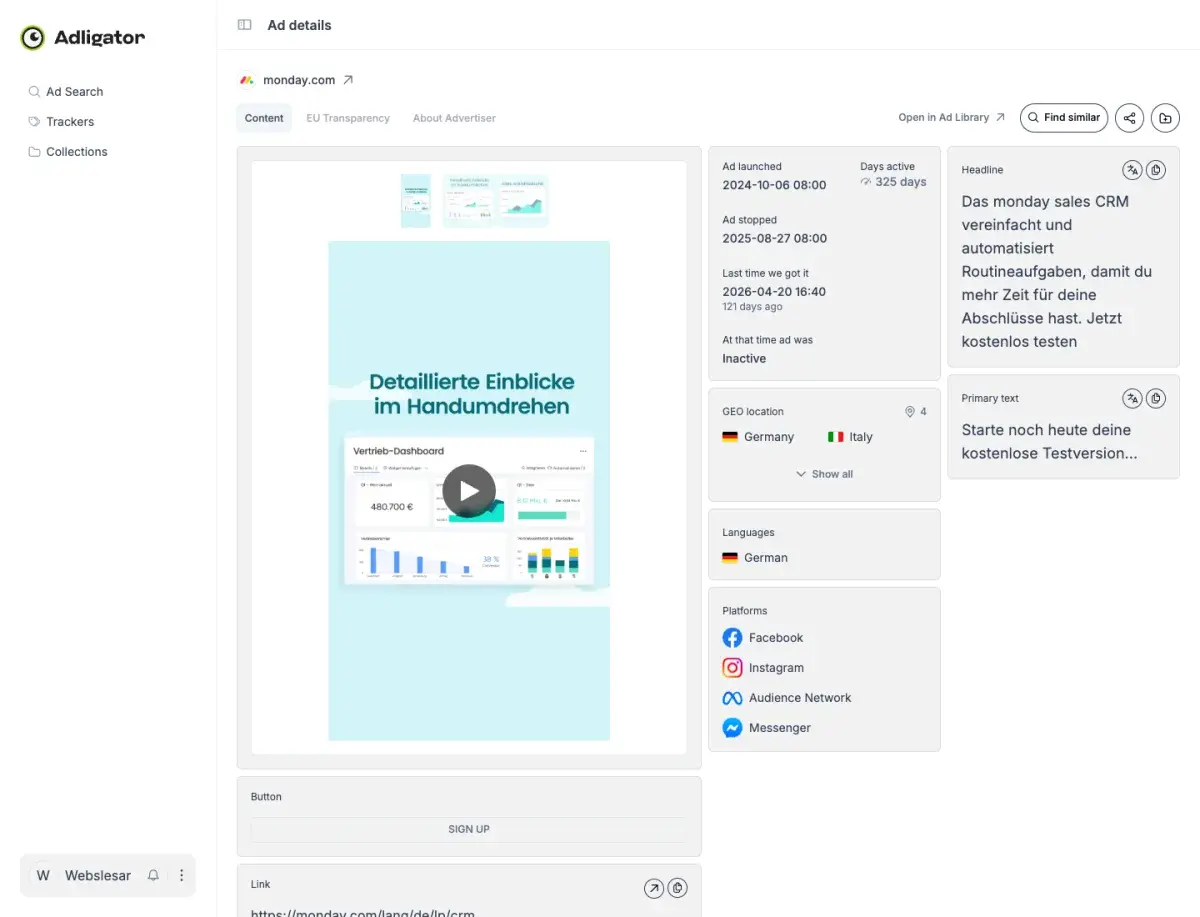 The champion's full record: launched 6 Oct 2024, retired 27 Aug 2025 after 325 days, German-language CRM headline, SIGN UP button to a dedicated landing page.
Why do these survive while thousands die? Common traits, visible right in the cards:
- They're mid-funnel workhorses, not attention bait. Plain benefit headline, product UI, free-trial ask. Nothing that fatigues.
- They sell a specific product to a specific market — sales CRM to German-speaking SMBs — instead of "work OS for everyone."
- DCO keeps them internally fresh. One "ad" at 325 days is really dozens of rotating component combinations, so the audience never sees the exact same unit twice.
- They're localized properly: German copy, German LP, German price points — not a translated English ad.
What a smaller SaaS team should steal (and what to skip)
Steal these three patterns:
- Component thinking over ad thinking. Ship every test as headline variants + 2–3 media variants in a DCO/flexible setup and let Meta assemble. You don't need monday.com's volume — even 3 headlines × 3 visuals gives the algorithm nine units to optimize across.
- One product, many verticals, dedicated LPs. Their real-estate CRM angle is the same product with a resliced promise and its own landing page. Take your tool, pick your two strongest industries, and build an angle + LP pair per industry before you build a second campaign.
- Calendar-driven creative changeover. Set a batch launch date and a review date. Kill everything below your bar in under two weeks; let proven winners run for months. Longevity is earned in the auction — respect it instead of "refreshing" working ads out of boredom.
Skip these:
- The llama. The brand-video layer assumes an audience pool and a content team a 10-person SaaS doesn't have. Direct-response first.
- 29-country blasts. Without monday.com's localization machine, broad multi-GEO delivery just buys cheap, unconvertible reach.
- Competitor-comparison LPs as a first move. Conquesting pages work from a position of strength (and with legal review); they're a scaling lever, not a starting point.
How to run this teardown on any competitor
The full recipe, reproducible in about 15 minutes:
- Start in Meta Ad Library — search the brand's page, set Active status. You'll see what's live today. At monday.com's scale (~1,300 active ads), that's also where the manual road ends: the Library can't sort by runtime, can't count formats, and shows no history.
- Search the page ID in Adligator — one search returns the whole collected library. Sort by Longest running: the top rows are the ads that have been paying for themselves for months.
- Probe with filters — format by format, language by language, CTA by CTA. Ten minutes of filtered searches produced every number in this article.
- Open the detail cards of the top 5 runners: launch dates, stop dates, GEOs, landing URLs, full copy. Quote hooks from here.
- Create a tracker on the page — from then on, new creatives are collected daily, and the Analytics tab turns the library into charts: funnel destination, language mix, and a launch-cadence heatmap that makes batch patterns (like monday.com's October launches) jump out visually.
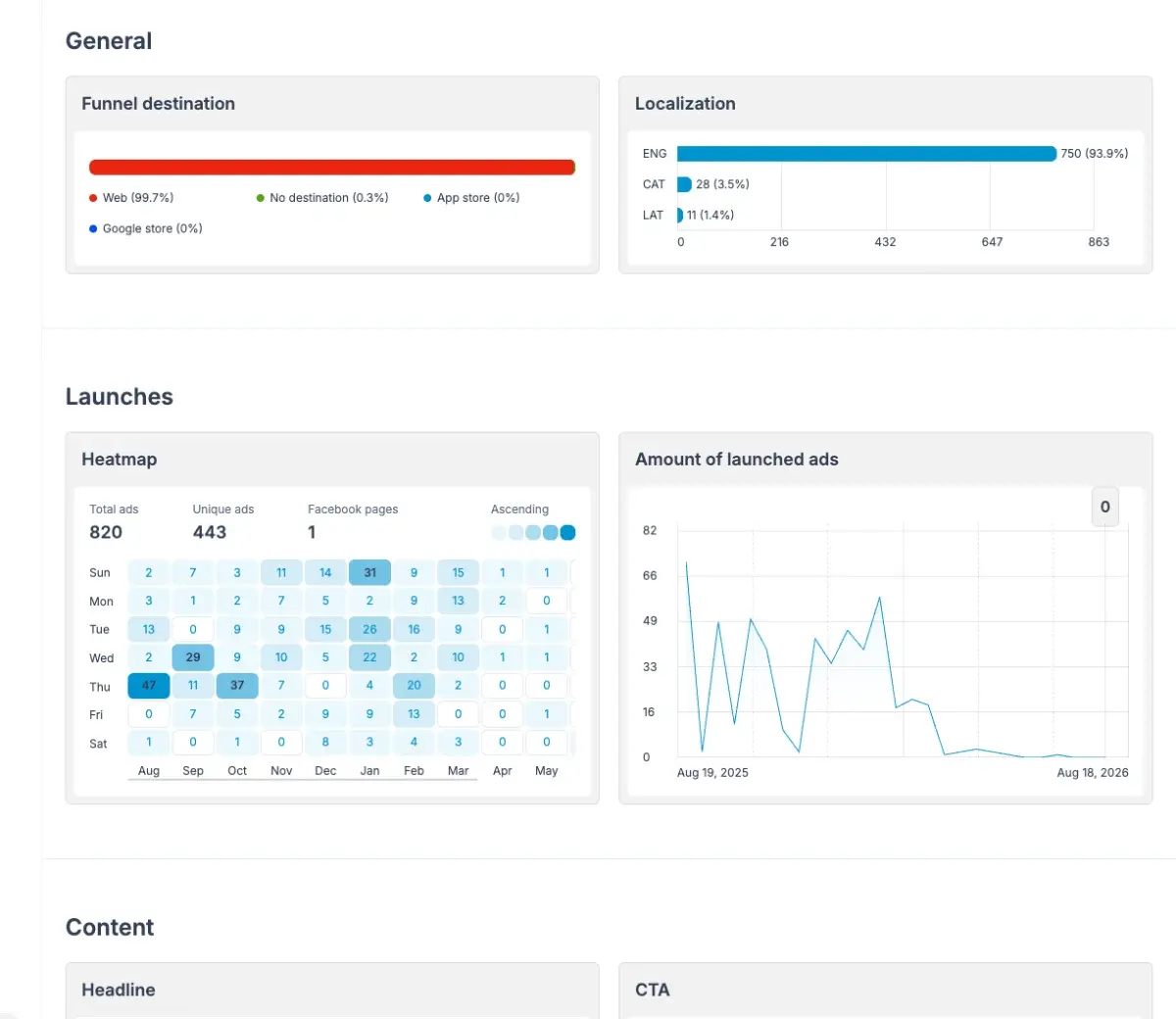 The Analytics tab on a tracked B2B SaaS advertiser (Foreplay): 820 ads collected, 99.7% web funnel, 93.9% English copy, and a launch-cadence heatmap by weekday.
That dashboard above is a real tracked B2B SaaS advertiser (Foreplay, an ad-creative platform): 820 collected ads, a 99.7% web funnel, 93.9% English copy, and the exact weekdays they ship new creatives. Point the same tracker at your closest competitor and you get their version of this article, updated daily.
Run this exact teardown on your competitor — search their page in Adligator free.
FAQ
Do Facebook ads work for B2B SaaS?
monday.com's library is the strongest possible yes: roughly 1,300 ads active in Meta Ad Library as of August 2026, with individual creatives sustained for 325 days. B2B SaaS works on Meta when the creative shows the product, the CTA leads to a self-serve trial, and winners get months — not weeks — to compound.
How much does monday.com spend on advertising?
Meta doesn't publish spend, and any precise number would be a guess — which is why this teardown avoids one. What's public: monday.com's IPO filing disclosed about $191 million of sales-and-marketing spend in 2020, more than its revenue that year. For estimating a competitor's Meta budget from library signals, see our Gymshark spend estimation breakdown.
What ad formats work best for SaaS?
In monday.com's collected library, about 97% of ads are DCO — Meta assembles headline, media and text combinations automatically. Plain video and carousels together are under 3% and serve brand plays, not signups. The winning unit is a product-UI screenshot or short screen recording plus a benefit headline.
How do I research a SaaS competitor's ads?
Open their page in Meta Ad Library for the live view, then run their Facebook page ID through an ad intelligence tool to sort by days active, split by format and language, and read landing pages. Longevity is the signal that separates winners from tests.
Conclusion
Strip away the scale and this b2b saas facebook ads case study reduces to four habits: ship component sets instead of one-off ads, reslice one product into vertical-specific angles with their own landing pages, run creative rotation on a calendar, and let longevity — not opinion — decide what lives. monday.com's 1,880-ad library is simply those four habits compounded for years.
Your competitor's library tells an equally specific story. It's public, it's searchable, and it takes one page-ID search to open.
Ready to read it? Search your competitor's page in Adligator free — and put a tracker on your real rival so the Analytics view stays current while you build.
Related Reading
- Competitor Landing Page & Funnel Analysis: How to Decode Facebook Ad Funnels
- Copying Competitor Facebook Ads Is Quietly Killing Your ROAS — Here's What to Do Instead
- How to Estimate Competitor Facebook Ad Spend Using Spy Tools and Ad Library Data
- Facebook Ad Creative Trends 2026: What Spy Tools Reveal About Winning Formats, Hooks, and CTAs
